

The rapid development of Unmanned Aircraft Systems (UAS, aka drones) is creating new opportunities across logistics, infrastructure, energy, maritime activities and a growing range of commercial and public-sector applications. As operations become more numerous, diverse and complex, however, ensuring that drones can operate safely and efficiently requires more than individual authorizations and traditional airspace-management processes.
Unmanned Aircraft System Traffic Management (UTM) provides the digital backbone for this evolution. By connecting operators, authorities and other airspace users through automated protocols and information exchange, a UTM framework can support the safe, efficient and scalable integration of drones into the airspace.
For national authorities, the challenge is therefore not simply to deploy a technology platform. It is to design an end-to-end UTM framework in which governance, regulation, operations, technology and infrastructure work together, and in which the underlying economic model can support the system over the long term.
From technology deployment to a national UTM framework
A successful UTM implementation starts with a clear definition of each stakeholder's role. Regulatory authorities must establish the rules, certification requirements, and oversight mechanisms, while service providers and air navigation organizations must ensure UTM integrates operationally with the broader aviation ecosystem.
The framework must also accommodate very different types of users. A small operator performing occasional surveying missions has fundamentally different requirements from a large logistics company conducting thousands of delivery operations. Designing a system that can accommodate this diversity while maintaining common safety and interoperability standards is therefore critical.
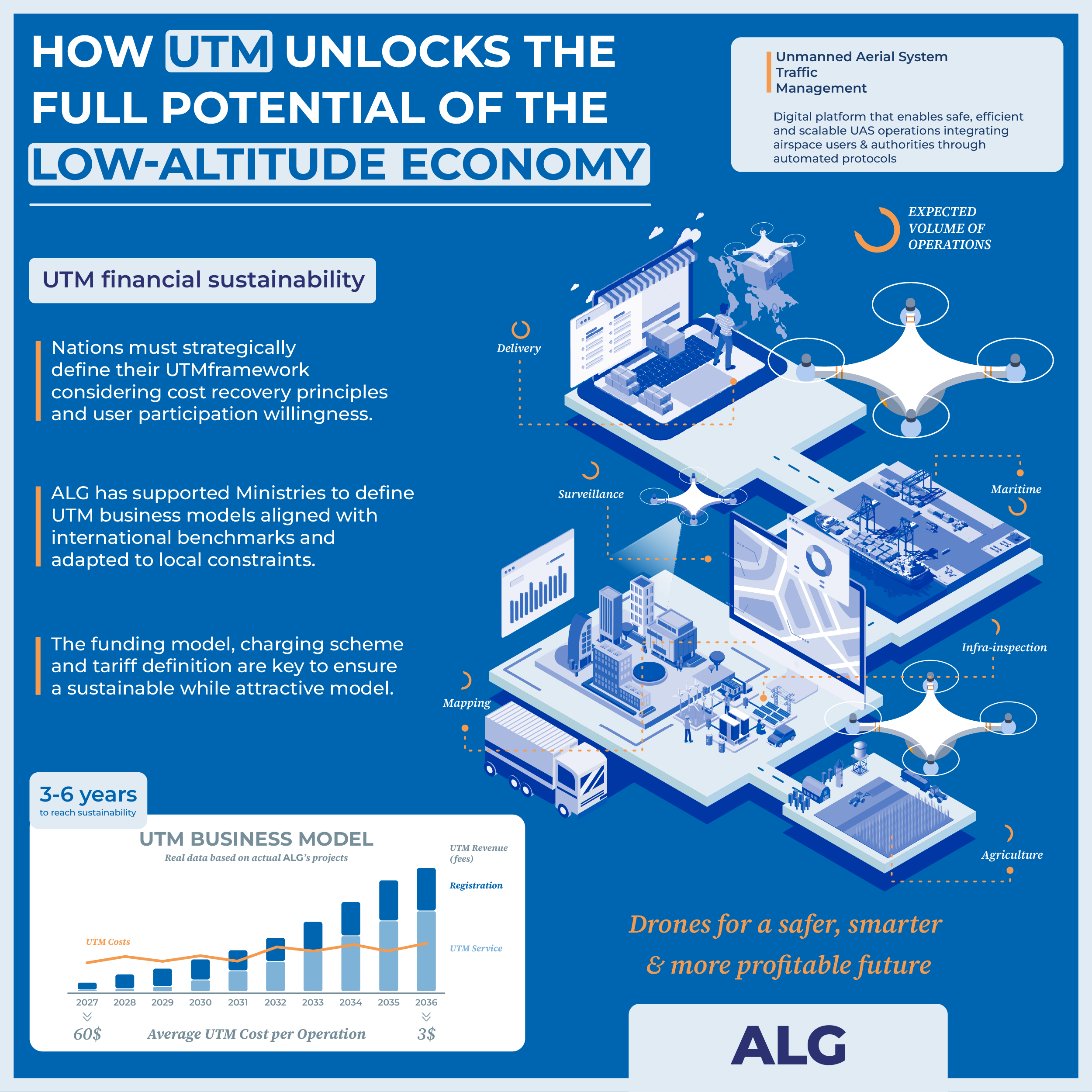
The potential applications are already broad. Delivery, maritime operations, renewable-energy inspection, infrastructure inspection, surveying and façade cleaning illustrate how UAS can generate value across sectors of the so-called Low-Altitude Economy. As operational volumes grow, a well-designed UTM framework can help reduce administrative friction, improve visibility of operations and provide the infrastructure needed for new use cases to emerge.
Making UTM financially sustainable
The economics of UTM deserve the same strategic attention as the technology itself. National authorities need to determine how the initial investment and ongoing operating costs will be funded, while ensuring that the resulting charges do not unnecessarily constrain market development.
A sustainable model can combine registration-related fees (covering activities such as UAS, pilot or operator registration) with UTM service fees, potentially based on subscriptions, usage or a combination of both. The appropriate charging structure depends on the characteristics of the local market, the cost base, the expected evolution of demand and users' willingness to participate.
Importantly, UTM economics can benefit from scalability. While the platform requires initial CAPEX and ongoing OPEX, increasing operational volumes can spread fixed costs across a larger number of users and operations. As a result, the average UTM cost per operation can decrease significantly as the ecosystem matures.
This creates an important strategic opportunity: rather than designing tariffs exclusively around short-term cost recovery, authorities can consider how pricing influences adoption, operator participation and the long-term sustainability of the ecosystem. Depending on the market assumptions and implementation approach, a UTM business case may reach financial sustainability within a relatively limited number of years.
Navigating uncertainty through robustness
The outlook for UAS operations and UTM adoption is subject to several sources of uncertainty. Market growth may differ from initial expectations depending on the pace of regulatory development, technology adoption, stakeholder appetite and the emergence of new use cases. As a result, forecasts of operators, operations and associated UTM revenues and costs should be understood as scenarios rather than fixed outcomes.
This uncertainty has direct implications for the financial model. A funding scheme designed around a single demand forecast may create challenges if adoption is slower than expected, while an overly conservative model could constrain investment and market development. Understanding the market outlook and testing the business model under different demand scenarios are therefore essential to determine how resilient the UTM framework is to changes in market conditions.
Robustness and adaptability should consequently be built into the framework from the outset. Pricing mechanisms, cost-recovery targets and implementation milestones can be designed to evolve as actual demand becomes clearer, with periodic reviews allowing tariffs and the funding mix to be adjusted accordingly. The objective is not to predict the market with precision, but to build a UTM business model capable of adapting to it.
Designing the right model for each market
Due to all these considerations, there is no single UTM funding model that can simply be replicated across countries. International benchmarks provide useful reference points, but each national framework has its own regulatory structure, aviation ecosystem, cost base, market maturity and development objectives.
The challenge is therefore to translate international experience into a model adapted to local conditions. This requires combining strategic decisions (such as the level and timing of cost recovery, the role of public funding and the desired pace of implementation) with data-driven pricing decisions, including the charging unit, tariff levels, subscription structure, usage fees and potential segmentation of users.
This is where UTM moves beyond being an infrastructure project and becomes a strategic market-enabling programme. The right pricing architecture can help balance three objectives that are sometimes difficult to reconcile: keeping access attractive for operators, providing sufficient funding for the UTM ecosystem and creating a predictable path toward financial sustainability.
Final considerations
For national authorities considering UTM, the key question is therefore not simply “How much will the system cost?”, but rather “How should we design the framework so that the system, its users and the wider drone ecosystem can grow together?”
ALG supports public authorities in addressing this challenge from an integrated perspective, combining strategy, regulation, operations, technology and infrastructure with the economic design of the framework. This includes developing UTM business and funding models, assessing international benchmarks, defining charging architectures and developing data-driven tariff schemes adapted to the characteristics and objectives of each market.
UTM is ultimately more than a digital platform. It is an enabler for safer skies, more efficient operations and a new generation of sustainable drone applications that will unlock the wider Low-Altitude Economy.
About the authors

Marina Estal Muñoz
Aeronautical engineer with extensive experience in airspace policy, strategic airspace management and U-space implementation. Expertise in civil-military coordination and aviation regulatory frameworks, supporting public and private stakeholders across the aviation ecosystem. Engagement Manager in the aviation practice.

Víctor Díaz Caballero
Aeronautical engineer holding Master's degrees from UPC and Cranfield University. Experience in strategic consulting across aviation, space and digital infrastructure, specializing in satellite-based services, ATM/CNS and UTM/U-space. Expertise in business model development and strategic roadmap design. Consultant in the aviation practice.

Dorothy Ann Van der Ent
MSc in Aerospace Engineering with a specialization in Airports. Over 4 years of experience in aviation projects related to airport operations, drone operations and operational performance. International experience across Europe, Latin America and the Middle East. Consultant in the aviation practice.


