

For decades, fuel tankering in aviation has been one of the quietest levers in airline cost management: uplifting more fuel than a sector requires, in order to buy less (or none) at a costlier downstream station. It rarely reached senior management’s agenda; it sat as a parameter inside the flight-planning system, applied automatically, city pair by city pair, day after day. And it worked: EUROCONTROL estimated that European carriers collectively netted around €265 million a year from this practice.
That quiet arrangement has come to an end. Fuel is now more expensive and more unevenly priced than at any point in the last decade, making the underlying arbitrage more valuable than ever. Yet at the same moment, the practice has been capped in Europe and stripped of its free carbon: ReFuelEU Aviation requires operators to uplift, at each EU airport it departs from, at least 90% of the trip and taxi fuel required by its flights leaving that airport over the year, and free EU ETS allowances for aviation reached zero in 2026.
The result is an unusual position for a cost lever. The incentive to use it has never been stronger, and the tolerance for using it has never been lower. Tankering has stopped being a technical setting and has become a governance question, spanning fuel procurement, flight operations, network planning and sustainability reporting. In most airlines, it still has no clear owner.
A practice built on price gaps
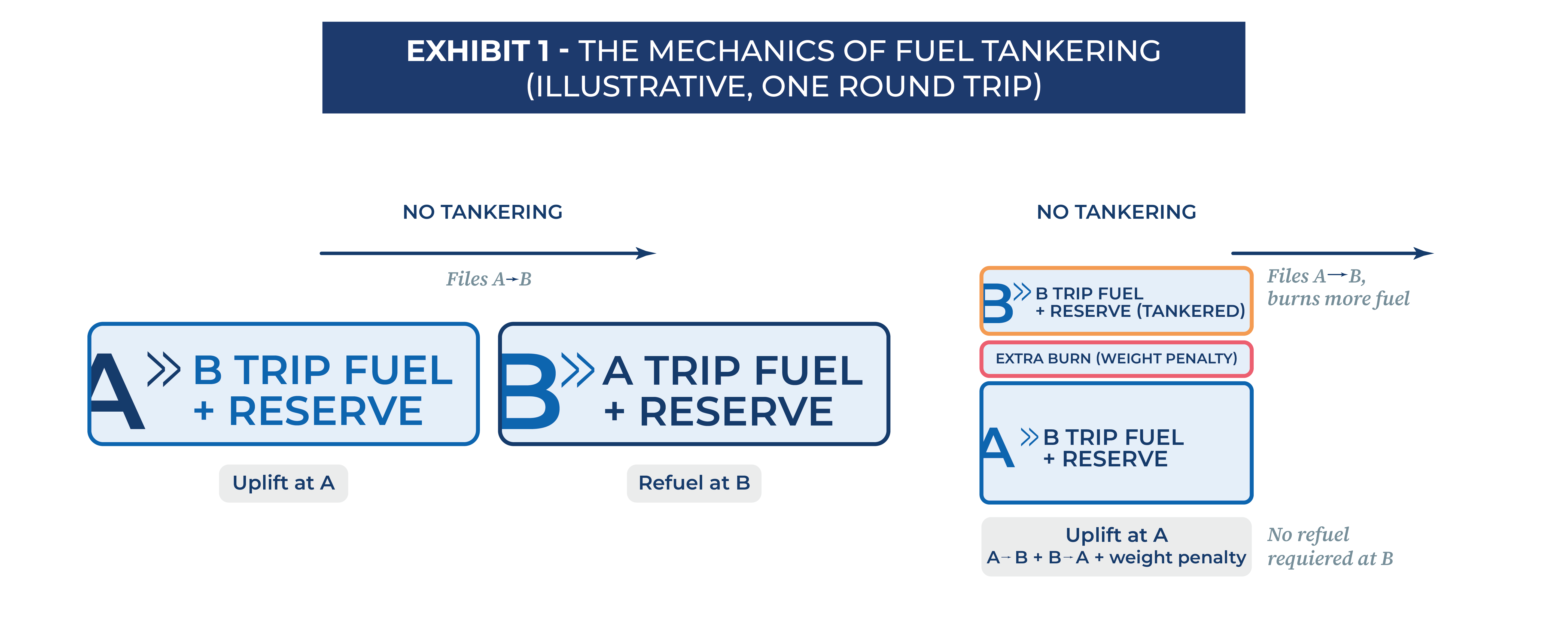
Tankering means loading an aircraft with more fuel than the immediate flight requires (trip fuel plus regulatory reserves) so that the extra can be carried through and used on a later sector, most often the return leg. In its full form, the aircraft uplifts everything it needs for the round trip at the departure airport and doesn’t load any fuel at the destination; in its partial form it carries part of the return fuel and tops up on arrival.
A minority of these decisions are genuinely operational. EUROCONTROL puts that share at around 10%: anticipated fuel shortages, industrial action, restricted opening hours, unserviceable refueling equipment, or doubts about fuel quality at the next stop. The remaining 90% is pure price arbitrage — fuel is cheaper here than it will be there, so the aircraft carries it across.
Why the incentive has grown in 2026
Fuel has historically represented approximately a quarter of airline operating costs. In 2026 that share has soared: after the supply disruption of late February, IATA expects an average jet-fuel price of about USD 152 per barrel for the year, an industry fuel bill of USD 351 billion, and fuel at roughly 31% of operating costs (close to a third of the cost base, and one of the few large lines where management action) hedging, procurement and fuel-efficiency programs — can still move the outcome by a few percentage points within a year, even though the price level itself is set by the market.
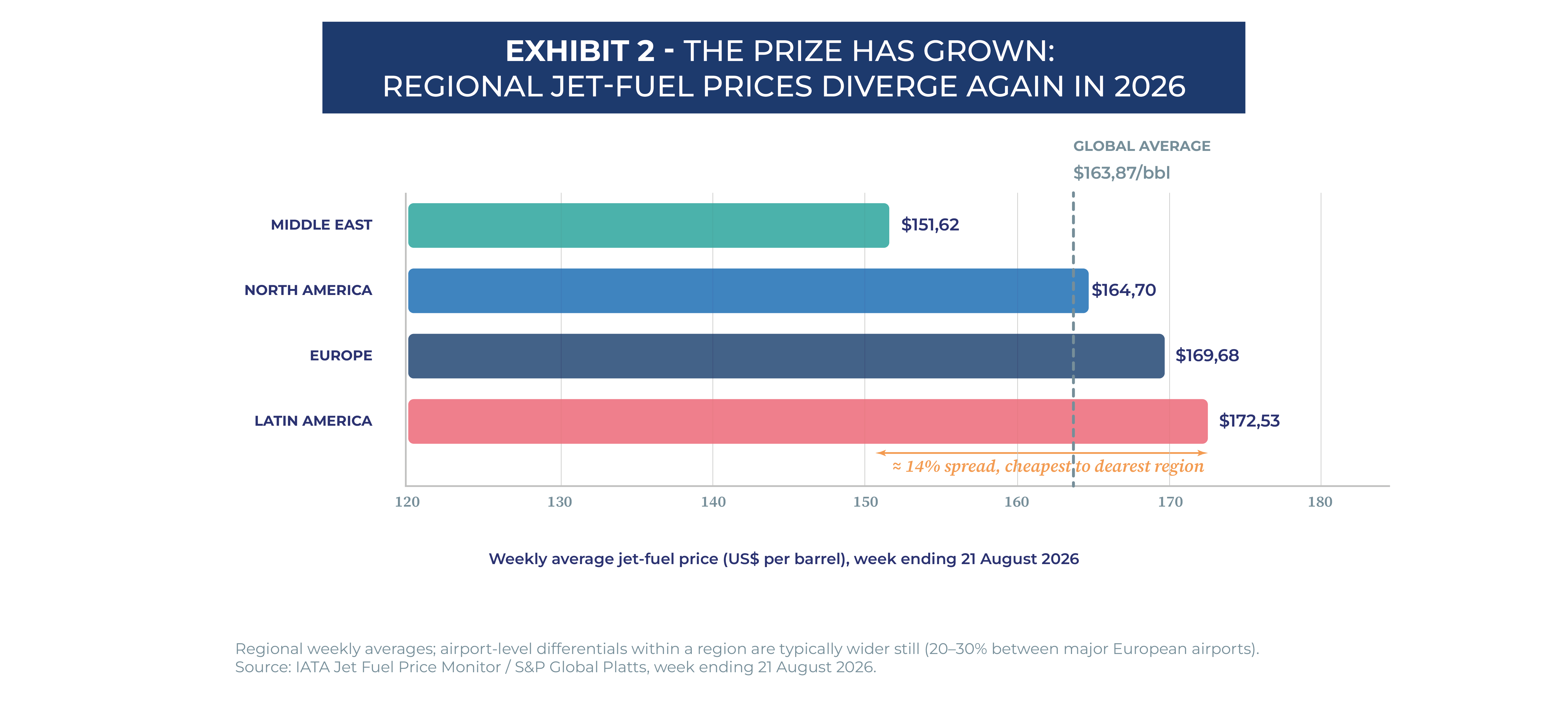
What matters about tankering in aviation, however, is the dispersion of prices across an airline’s network. Jet fuel is never uniformly priced across a network: local taxation, into-plane and handling fees, the depth of competition among resellers, storage and logistics, currency, and negotiated volumes all pull prices apart. This year the dispersion has widened, because the move has been driven by refining rather than crude — the global jet crack spread has more than tripled year on year to around USD 71 per barrel, and crack spreads vary far more by region than crude does.
Regional benchmarks now sit some 14% apart, and airport-level gaps are wider still. EUROCONTROL’s benchmarking found differences of 20–30% between major European airports, Amsterdam against Ibiza, Hamburg against Oslo, Heathrow against Glasgow, and more than 50% across Europe as a whole. Outside Europe, where national subsidies or tax regimes come into play, the spreads can be even larger. Every percentage point of that gap is worth more in cash today than it was two years ago. A wider gap means a larger prize for every tonne carried, so the incentive to tanker rises mechanically with the spread. And because the decision is automated, that increase happens without anyone revisiting the policy; the incentive grows precisely as the regulatory tolerance for it disappears.
The physics: extra fuel is never free to carry
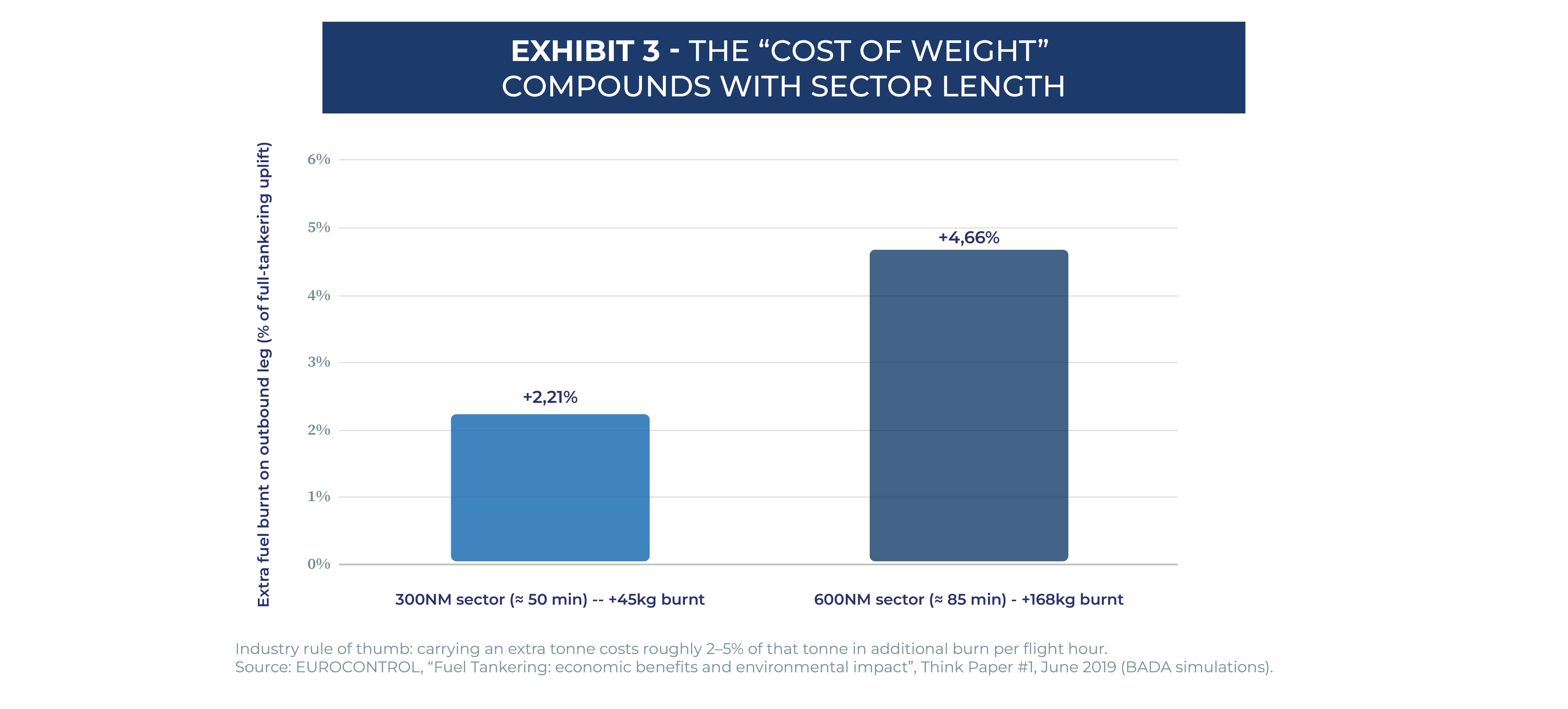
Against that benefit sits a cost that has not changed at all. IATA formalizes it as Cost of weight: the additional burn caused by any extra weight on board, whether passengers, cargo or fuel itself. The working rule of thumb across flight-operations and operations-research communities is that carrying a tonne costs roughly 2–5% of itself in extra fuel for every hour it stays on board, varying with aircraft type, altitude and speed regime.
A miscalibrated tankering program does not announce itself as a loss on the P&L; it shows up as marginally worse fuel efficiency across the fleet, and can run for months on stale price data before anyone notices.
A narrow break-even that carbon has moved, but not closed
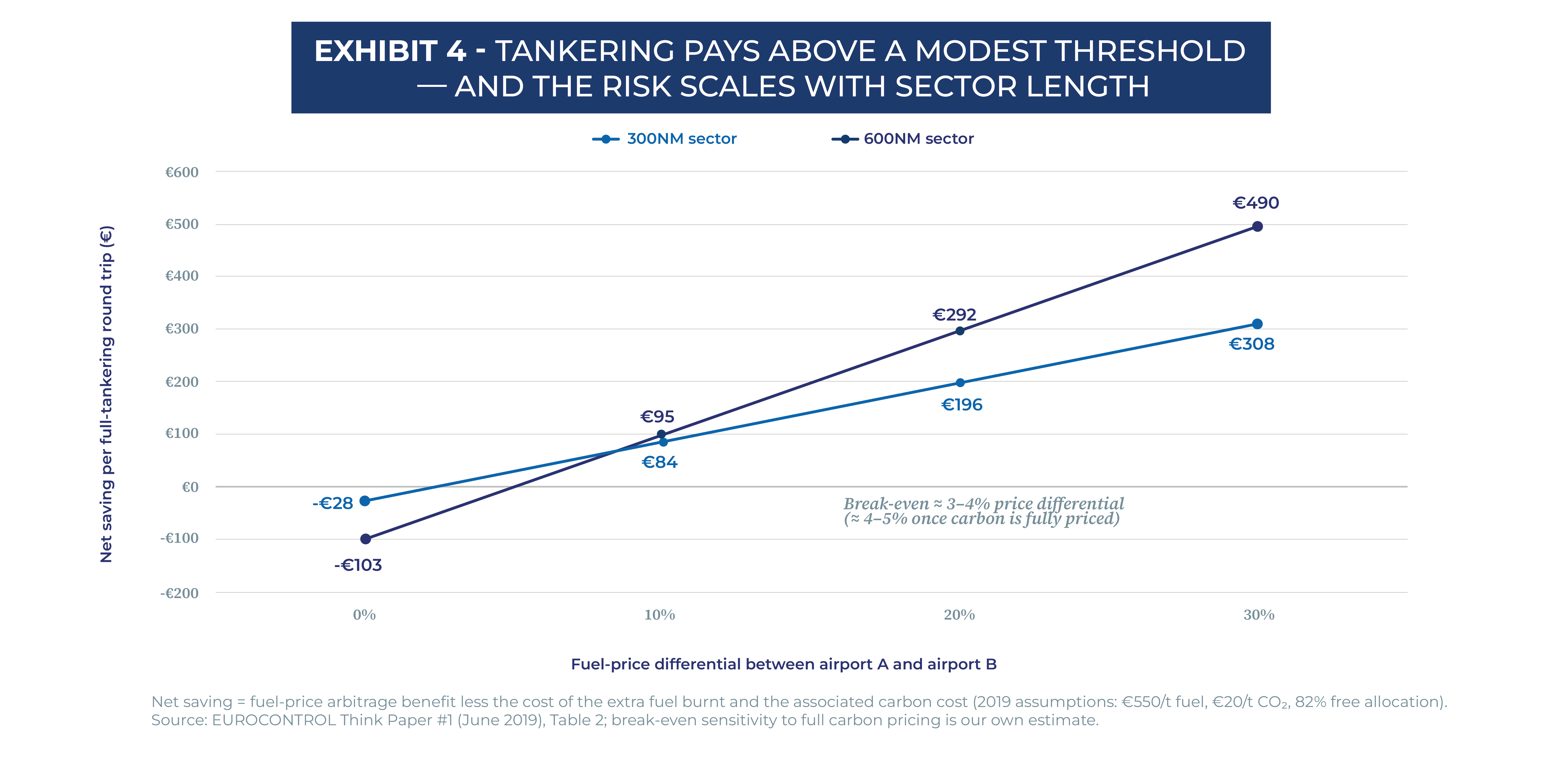
The decision reduces to a simple inequality: tanker only if the arbitrage benefit exceeds the cost of the extra burn and the carbon attached to it. At the assumptions used when the economics were first modelled (€550 per tonne of fuel, €20 per tonne of CO₂, 82% free allocation) the break-even sat at a price differential of only 3–4%. Set against real airport gaps of 20–30%, that explains why the practice became so widespread, and why flight-planning platforms were built to apply it automatically.
Full carbon pricing raises that threshold without closing it. Burning a tonne of jet fuel emits about 3.16 tonnes of CO₂; at an allowance price of €85, that is roughly €270 per tonne of fuel burnt, against some €11 under the old assumption of €20 with 82% free allocation. The break-even differential moves from around 3–4% to 4–5%.
The conclusion is uncomfortable but important: carbon pricing alone would not have stopped tankering. With regional gaps of 14% and airport-level gaps of 20–30%, the arithmetic would still favor the practice on a great many pairs. What has changed the answer inside Europe is regulation, not price. Carbon has, however, changed the ranking of routes: the penalty now scales with burn, so the long sectors where tankering looked most attractive are also those where the carbon cost bites hardest.
Private savings, public cost
Aggregated across the ECAC area as a whole, these are industry-wide figures, not a single carrier's; the picture becomes clearer still. The gross arbitrage benefit of tankering was estimated at around €440 million a year; after paying for the extra fuel and the carbon allowances attached to it, airlines retained roughly €265 million. Producing that saving required burning some 286,000 tonnes of additional fuel and emitting 901,000 tonnes of avoidable CO₂ a year, close to the annual footprint of a city of 100,000 people.
The savings accrue privately to the airlines that tanker; the emissions are a public cost borne by everyone. That is a textbook negative externality, and exactly the kind of gap between private and social cost that invites regulatory correction. Which is what happened.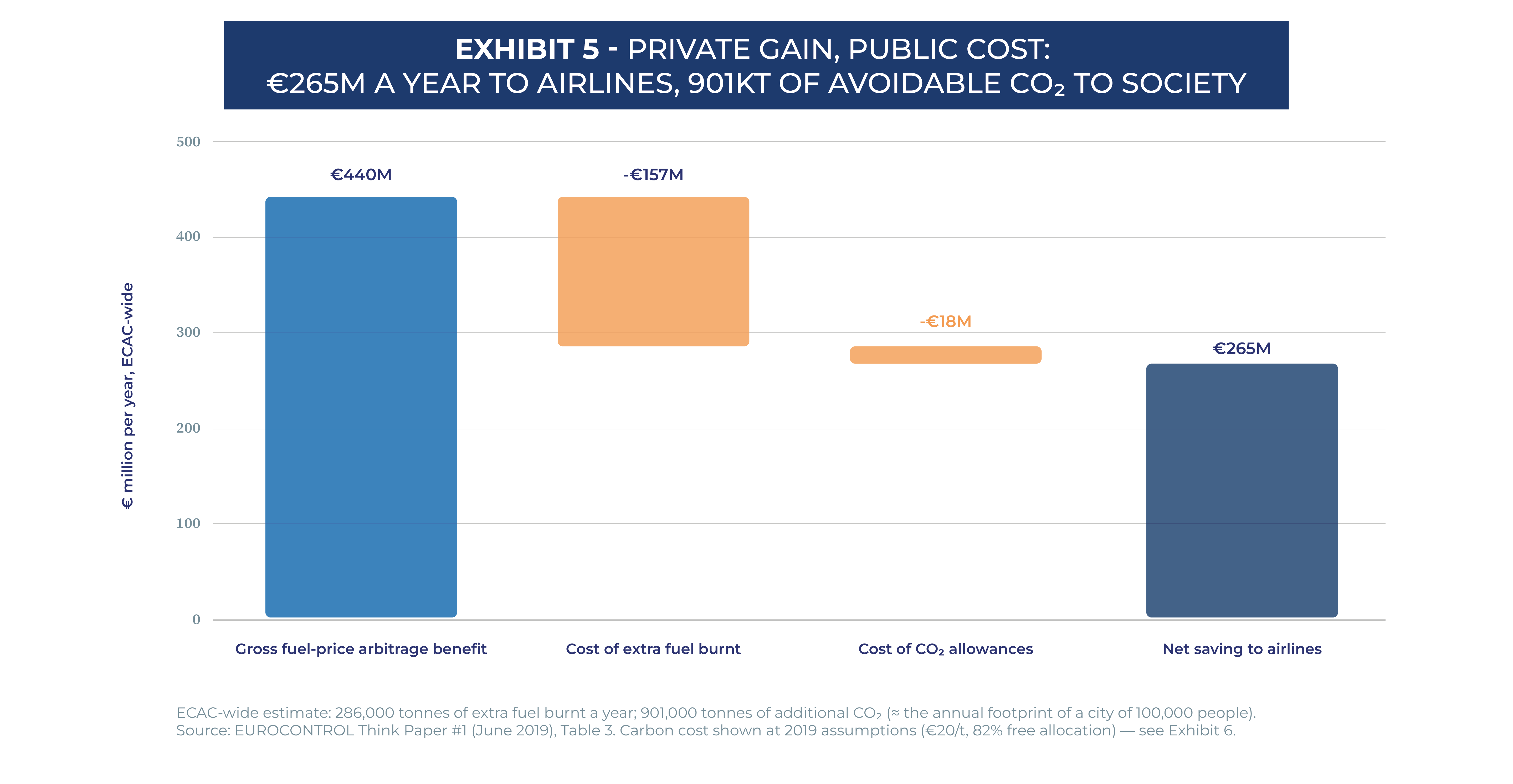
The regulatory turning point
ReFuelEU Aviation, Regulation (EU) 2023/2405, has converted a commercial judgement into a compliance obligation. In force since 1 January 2024 as part of Fit for 55, it requires aircraft operators to uplift at least 90% of their yearly aviation fuel requirement (trip and taxi fuel) at each EU airport from which they depart. The obligation is an annual average per airport rather than a flight-by-flight rule, which preserves operational flexibility but leaves compliance teams a running balance to manage all year.
Its reach is wide. It covers operators with more than 500 commercial passenger flights, or 52 cargo flights, departing EU airports annually, whether EU-based or not; Switzerland adopted the same regime from 1 January 2026, bringing Zurich and Geneva into scope. Reports are filed by 31 March each year through EASA’s platform and verified by an accredited third party, on a model borrowed from EU ETS practice. Exemptions exist for serious and recurrent operational difficulties, but they must be documented in advance and defensible under verification. Penalties are set at a minimum of twice the annual average price of aviation fuel per tonne of shortfall, calibrated deliberately to exceed any arbitrage gain, and already translating into fines in the order of €1,500 per non-uplifted tonne.
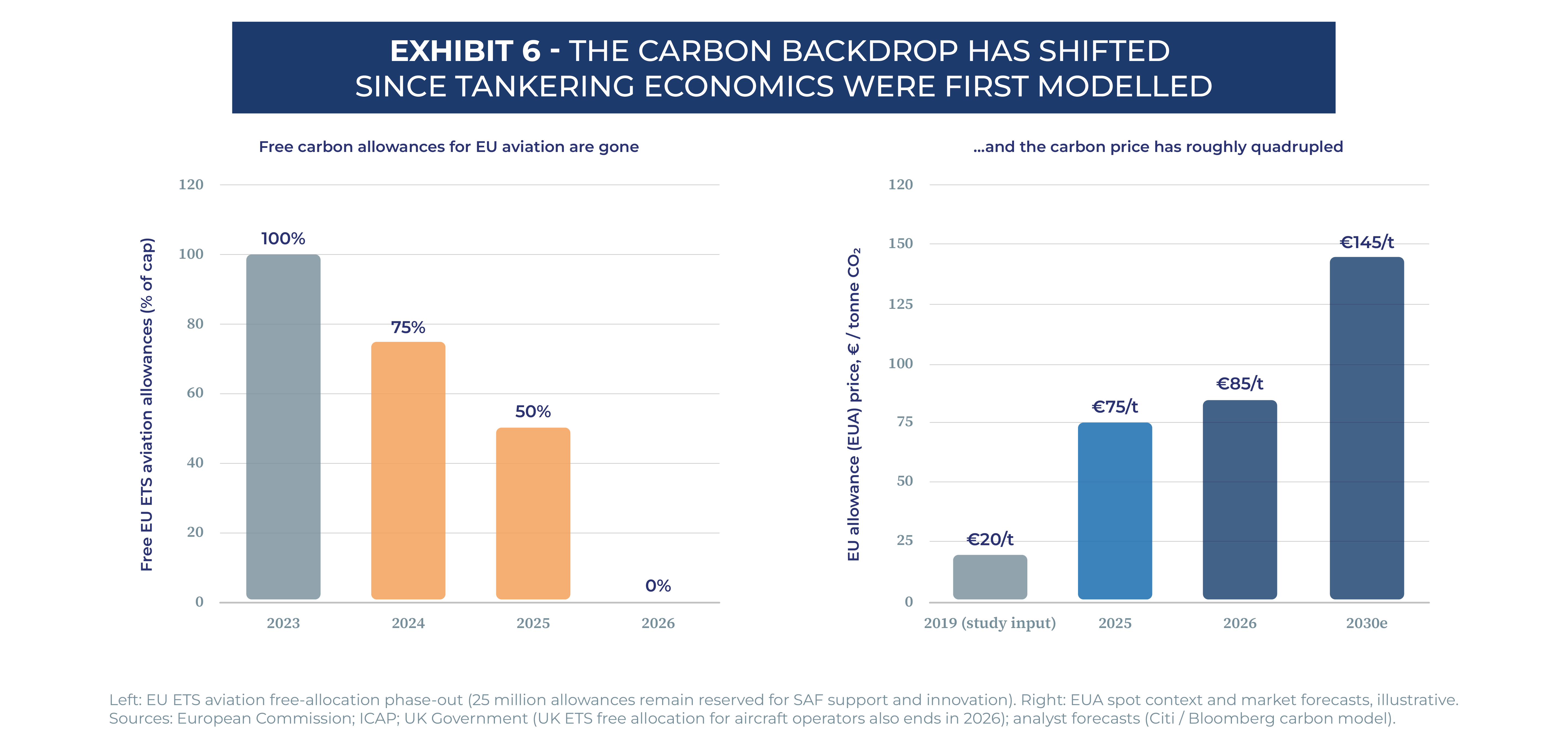
Running in parallel, the carbon side of the equation has closed. Free EU ETS allowances for aviation fell from 100% of the cap in 2023 to 75% in 2024, 50% in 2025 and zero from 2026; the UK ended free allocation for aircraft operators on the same date. Allowance prices have meanwhile moved from the €20 assumed in the original tankering economics to the mid-€70s and €80s, with analyst base cases pointing to roughly €145 per tonne by 2030.
One asymmetry deserves attention, because it will shape where the practice migrates. The obligation attaches to the airport of departure, not to the nationality of the operator. Every airline leaving an EU airport is covered, Iberia at Madrid, Delta at Paris, Emirates at Frankfurt, and no airline leaving a non-EU airport is, European carriers included. Lufthansa uplifting at New York for the flight home to Frankfurt sits outside Article 5 in exactly the same way as Emirates uplifting at Dubai.
In practice, the gap is also narrower than it looks, because the cost of weight does much of the regulator's work. Fuel carried for eight or ten hours is heavily taxed by its own burn penalty, so inbound tankering seldom pays off on long-haul sectors. Where it does pay is on short flows from nearby non-EU markets, the UK, Morocco, Türkiye, the Balkans, and that is both where the real exposure sits and where equivalent rules are most likely to appear next.
From calculator to governance: what airlines should do now
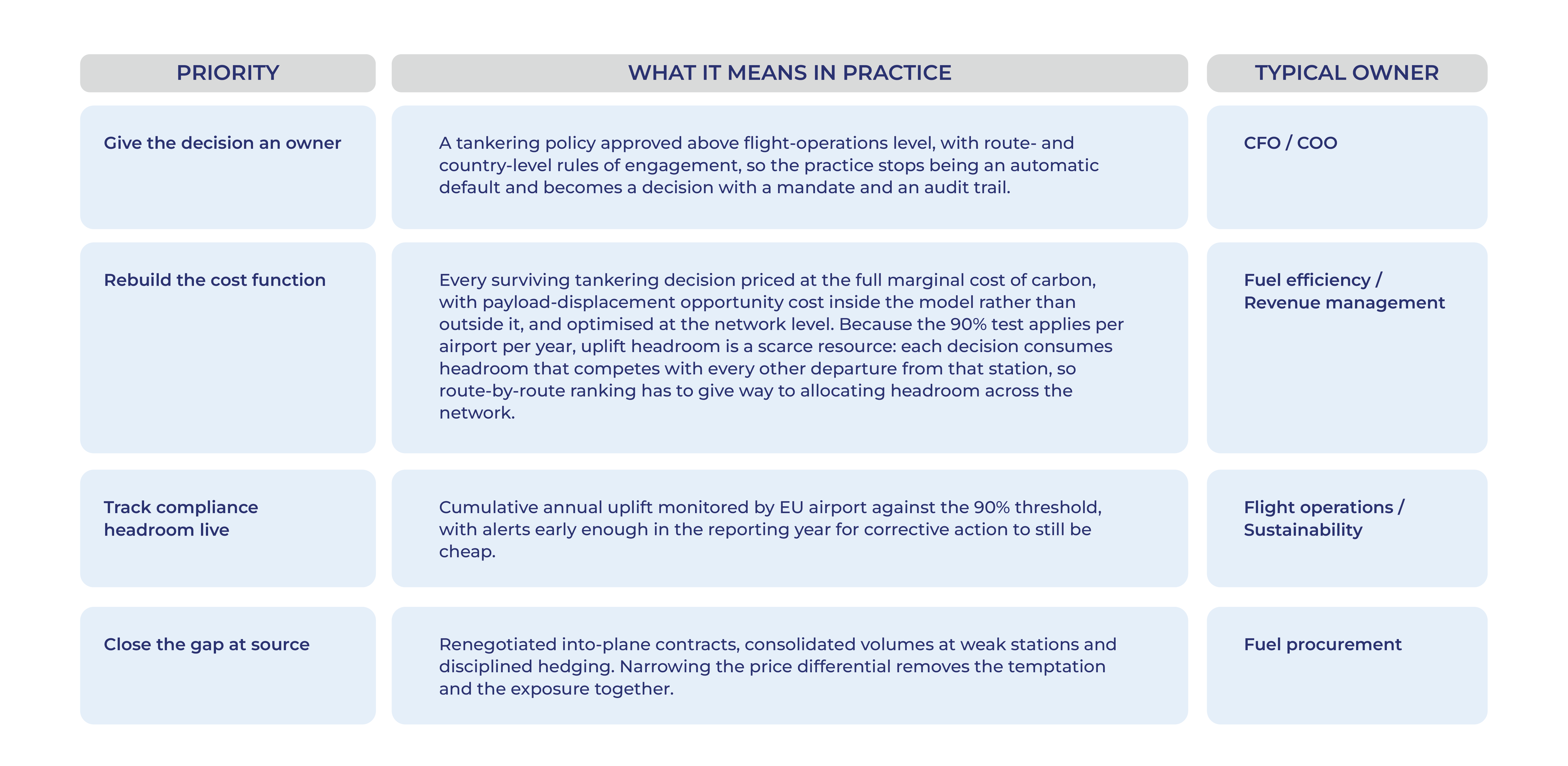
A compliance patch on the flight-planning system is not a response. Four moves turn tankering from an unmanaged default into a decision that is governed, correctly priced, and auditable.
Conclusion: the end of a quiet arbitrage
Fuel tankering is a textbook case of a decision that is locally rational and globally costly, and the regulatory environment has finally caught up with the economics. The risk for airlines is not that the practice disappears; it is that it continues by default, buried in routine software rather than visible as a discrete line on the P&L, until it surfaces as a verified shortfall and a penalty priced to hurt.
Airlines that rebuild the decision, pricing carbon at its full marginal cost, tracking compliance headroom in real time, being honest about payload and performance, and attacking the price gap through procurement, will keep the legitimate savings that remain, avoid material penalties, and gain a quantifiable sustainability data point in the process.
With extensive international experience across airline strategy, fuel and operations economics, and aviation decarbonization, we support clients in quantifying these trade-offs, building the governance around them, and turning compliance obligations into durable cost and sustainability performance.
About the authors

Fernando Hernández
BSc and MSc in Aerospace Engineering with a Master's thesis on the effects of non-CO2 impacts of aviation. Over 5 years of experience in large infrastructure projects, spanning airports and renewable energy. Senior Consultant in ALG's Aviation practice.

María Romero
Aerospace engineer holding an MSc in International Air Transport Operations and Management, with expertise in airline operations, traffic analysis and strategic aviation projects. Hands-on operational experience at a European low-cost carrier. Senior Consultant in ALG's Aviation practice.

Hernán Sznycer
BA in Business Administration and MSc in Finance. Senior Engagement Manager in ALG specializing in Air Transport Economics.


