
Digital & AI

Driving business impact through tailored data and AI strategies, scalable solutions and end-to-end transformation
ALG is a specialised Digital & AI partner for transport and infrastructure. We combine deep knowledge of the aviation, maritime, logistics, and land transport value chains with hands-on digital and AI engineering capabilities. We support public authorities, operators, regulators, investors, and multilateral organisations in designing digital and AI strategies, building production-grade solutions, and putting in place the governance, skills, and operating models needed to capture real value from data and AI.
Where generalist AI providers bring technology looking for a problem, we bring twenty-five years of transport intelligence and build AI around the way the industry actually works.
We help organisations decide where AI can create value and how to capture it.
Our approach starts with a structured maturity assessment covering data, AI, talent, infrastructure, and governance, benchmarked against industry leaders in the sector. We then translate strategic ambition into a prioritised portfolio of use cases, clear business KPIs, and a realistic implementation roadmap, including the enablers that make it work in practice: operating model, data governance, organisational adoption, and scalable AI foundations.
We design full-fledged landed strategies ready to be executed. Clients should see their first use cases deployed within a few months of approving the roadmap.
We design, build, and deploy AI solutions that make it into production and stay in use.
We support our clients in strategizing the adoption of tools that best fit their business. In some cases, commercial off-the-shelf AI struggles with the operational reality of transport and infrastructure. In those cases, our teams of data scientists, Data & AI engineers, and domain experts develop tailored, enterprise-grade solutions covering agentic AI, optimisation engines, machine learning, graph analytics, NLP, and GenAI applications, predictive analytics, and real-time performance monitoring.
We are technology-agnostic. Where a commercial tool fits the problem, we configure it. Where it does not, we engineer a custom solution. In both cases, we make sure the result integrates with existing systems and workflows, so it becomes part of how the organisation operates and decides every day.
Capturing value from AI at scale usually means changing how the organisation works. It is not only about including new technologies within our processes, but to rethink how our CONOPS might change with new solutions. Usually. processes need to be redesigned, data and cloud platforms modernised, operating models adjusted, and internal capability built up.
We orchestrate this transformation end to end. Our work covers intelligent process redesign, cloud-native data architectures, AI governance frameworks, responsible AI, and EU AI Act compliance, and structured adoption programmes.
Every engagement follows a simple principle: each step should move the client closer to autonomy. By the end of the journey, the organisation owns the tools, the processes, and the skills.
Agentic AI & AI-Driven Operational Optimization
• Agentic AI solutions embedded in operational workflows, with human-in-the-loop control
• Optimisation engines for resource allocation, scheduling and planning
• Machine learning and reinforcement learning for strategic and tactical scenarios
• Simulation and decision-support systems
• Efficiency gains measured against operational KPIs

NLP, GenAI & Knowledge Intelligence
• Intelligent document processing and automated data extraction
• LLM-powered assistants, copilots and enterprise knowledge search (RAG)
• Automated reporting and regulatory text analysis
• Text, sentiment and unstructured-data analytics
• Domain-tuned GenAI grounded in the organisation's own knowledge

ML & Graph-Based Safety & Operations Intelligence
• Knowledge graphs and graph analytics (including GraphRAG) over safety and operations data
• Anomaly, pattern and weak-signal detection
• Cross-correlation and causation analysis between event types
• Risk, safety and fraud intelligence, such as the detection of abnormal operations or illegal activity
• Machine learning models for proactive decision support

Predictive AI for Performance Monitoring & Forecasting
• Forecasting models for demand, capacity, emissions and operational performance
• Large-scale KPI monitoring and outlier detection at multiple granularities
• Real-time anomaly alerting and proactive intervention
• Predictive AI combined with GenAI for explainable, decision-ready insight
• Executive and operational dashboards on modern BI architectures

Data Ecosystems & Collaborative Data Sharing Programmes
• Scalable big data architectures for multi-stakeholder data sharing in transportation
• Multi-source ingestion and integration (flight data, sensor and surveillance data, reports)
• Cross-organisation data governance, quality and regulatory compliance
• Data security, encryption and access control within collaborative ecosystems
• Privacy-preserving collaborative analytics

AI Governance, Risk & Regulatory Readiness
• AI governance frameworks, operating models and accountability structures
• EU AI Act readiness, risk classification and compliance roadmaps
• Model lifecycle management, validation and assurance, including agentic and GenAI systems
• AI vendor and solution due diligence (data protection, IP, security)
• Responsible AI policies, training and adoption programmes

OurClients


Relevantprojects

Data & AI strategy for the data management directorate of SANS
ALG supported SANS in the development of a comprehensive Data & AI strategy to scale and industrialize data-driven products across the organization. The work built on an existing analytics platform that had already enabled several high-value use cases, aiming to unlock further value through a more structured and scalable data management approach.
ALG assessed the current state of the Data Management Directorate, reviewing the technology stack, implemented use cases, key achievements and organizational setup. Benchmarking against leading ANSPs helped identify gaps and define improvement priorities aligned with industry best practices.
Based on these insights, ALG defined a three-year vision for the Directorate, including strategic objectives aligned with corporate priorities and a structured KPI framework. The team designed the target technology stack, considering functional requirements, costs and risks, and developed a workforce and talent plan covering capability needs, upskilling and sourcing strategy.
ALG also defined a Data Realisation roadmap, outlining key initiatives to drive adoption and value creation. The strategy was validated through engagement with C-level stakeholders, ensuring alignment, commitment and a clear path to implementation and organizational transformation.
Data Platform & Analytics Provider for EASA Data4Safety Programme
ALG supported EASA in the design, implementation and operation of the Data4Safety (D4S) platform, one of the largest collaborative aviation safety data initiatives globally. The work enabled the transition from reactive to proactive safety management by leveraging integrated, cross-industry data to identify risks and support evidence-based decision-making across the European aviation network.
ALG designed and deployed a cloud-based Big Data platform covering the full data lifecycle, integrating multiple data sources such as Flight Data Monitoring (FDM), air traffic data (ADS-B), safety reports, weather information and contextual exposure data. This provided a unified and scalable foundation for advanced analytics across traditionally siloed datasets.
The team developed a range of data products, including KPI computation pipelines, interactive dashboards and advanced analytics solutions such as machine learning models for use cases like CO₂ estimation. Close collaboration with airlines, ANSPs, CAAs and manufacturers ensured alignment with operational needs and regulatory requirements.
In addition, ALG implemented business intelligence and visualization capabilities to deliver performance dashboards, including blind benchmarking features that allow organizations to compare their performance against industry peers. This approach strengthened transparency, continuous monitoring and data-driven safety improvements across stakeholders.

CO₂ Estimation Demonstrator for EASA Data4Safety Programme
ALG supported EASA in the development of an AI-based demonstrator for CO₂ emissions estimation, contributing to the implementation of an EU-wide environmental labelling approach under the RefuelEU Aviation regulation. The work helped address the challenge of estimating future emissions, complementing the use of historical airline data for sustainability reporting.
We defined analytical methodologies to estimate CO₂ emissions during the cruise phase of commercial flights, leveraging aviation data available in the Data4Safety (D4S) Big Data platform. This included the design of data models and feature engineering approaches to transform raw flight data into meaningful inputs for predictive modelling.
ALG developed and tested machine learning-based demonstrators, covering data pre-processing, model implementation, training and validation. The prototype was deployed in a cloud-based environment to assess scalability and integration with existing data infrastructure.
The work resulted in a functional demonstrator capable of estimating CO₂ emissions for future scheduled flights, enabling EASA to assess the feasibility of predictive emissions modelling. It also contributed to building internal capabilities and practical know-how in applying AI in line with EASA’s machine learning guidance.

Data & AI Strategy for a Major Hub Airport in the Middle East
ALG supports a major hub airport in the Middle East in defining and activating a comprehensive Data & AI strategy to enhance decision-making across operations and commercial functions. The work helps the client assess its current data maturity, identify high-value use cases and establish a clear roadmap to scale data-driven capabilities in line with its digital transformation ambitions.
We assess the existing Data & AI landscape, covering systems, data quality, governance, processes and workforce readiness, while mapping core platforms such as AODB/AMS, BHS, ERP and commercial systems. Through stakeholder engagement, we capture key business needs and translate them into a prioritized portfolio of Data & AI use cases.
Building on these insights, we design the target operating model and governance framework and define a structured “use case factory” approach to identify and scale AI initiatives continuously. The engagement also includes the definition of a multi-year strategy and implementation roadmap, covering technology architecture and foundational enablers.
To ensure early impact, ALG supports the activation of key data capabilities and the delivery of three quick-win solutions: passenger forecasting, passenger segmentation, and commercial sales forecasting enhanced with GenAI.
ADAPT – Aviation Intelligence Platform for Data-Driven Assessments
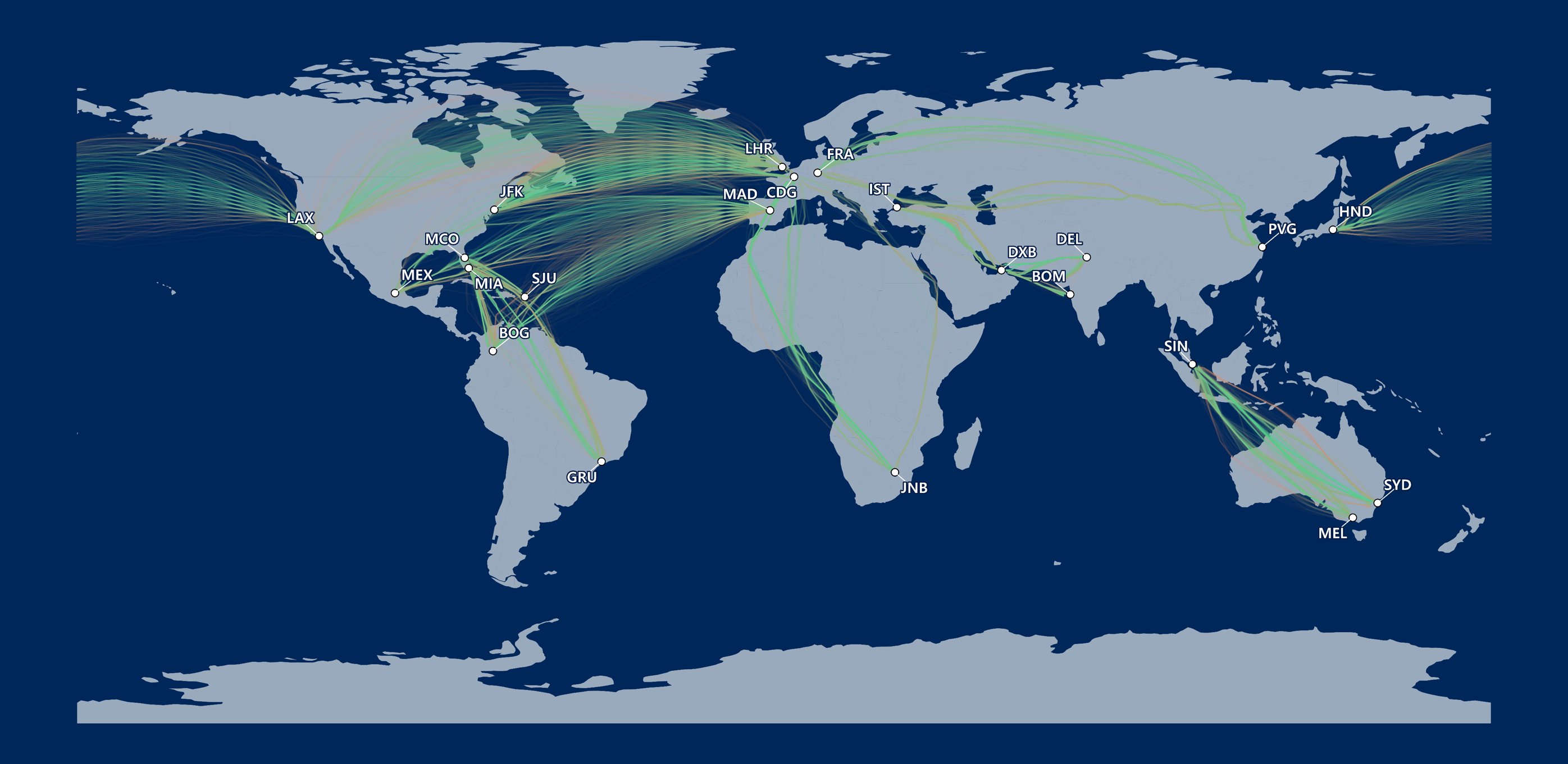
ALG developed ADAPT, an Aviation Intelligence Platform that combines ADS-B and operational datasets with proprietary analytical models to deliver advanced insights for aviation stakeholders. The solution leverages automated data pipelines and industry expertise to support both strategic and operational decision-making across 30+ projects.
ADAPT integrates multiple data sources, including flight trajectories (ADS-B), airport and runway information, airspace structures, schedules, and weather data, enabling enriched analytics and the computation of advanced operational metrics beyond standalone datasets.
Representative applications include:
1- Tocumen Airport (Panama): Supported capacity assessments by benchmarking ASMA additional time against peer airports, identifying future congestion risks and infrastructure bottlenecks.
2- Cayman Islands Airspace: Enabled estimation of airspace usage by analysing distance travelled per route and aircraft type, supporting fare strategy design despite limited tracking capabilities.
2- Heraklion Airport (Crete): Analysed waypoint usage and altitude profiles within the TMA, providing insights into traffic flows and operational behaviour during arrivals and departures.
Overall, ADAPT strengthens data-driven decision-making by delivering scalable, high-value analytics across diverse aviation contexts.

Operational Optimization with Machine Learning for Aeromexico
ALG supported Aeromexico in the development and integration of machine learning capabilities to enhance operational predictability and efficiency at its main hub, Mexico City International Airport (AICM), a highly congested environment. The work enabled improved situational awareness and more informed decision-making across both strategic and tactical operational phases.
ALG defined and implemented machine learning use cases tailored to key operational challenges. In the strategic phase, models were developed to identify critical flights with a high risk of causing schedule disruptions, supporting proactive planning and resource allocation. In the tactical phase, ALG designed predictive models to estimate Off-Block Times (OBT) with greater accuracy, improving real-time operational visibility.
The engagement covered the full data science lifecycle, including use case definition, data exploration and acquisition, feature engineering and model development. Algorithms were trained, validated and refined to ensure robustness and reliability, while results were translated into actionable insights for operational teams.
By embedding these capabilities into Aeromexico’s processes, the project strengthened operational efficiency, reduced uncertainty and enabled a more data-driven approach to managing complex airport operations.