

When the Strait of Hormuz stopped being a reliable route, regional trade found another way in. A growing share of Gulf-bound cargo began entering through the Red Sea and crossing the Arabian Peninsula by truck. For the ports receiving it, handling the ships proved to be only half of the equation. The other half was on the landside.
From chokepoint to land bridge
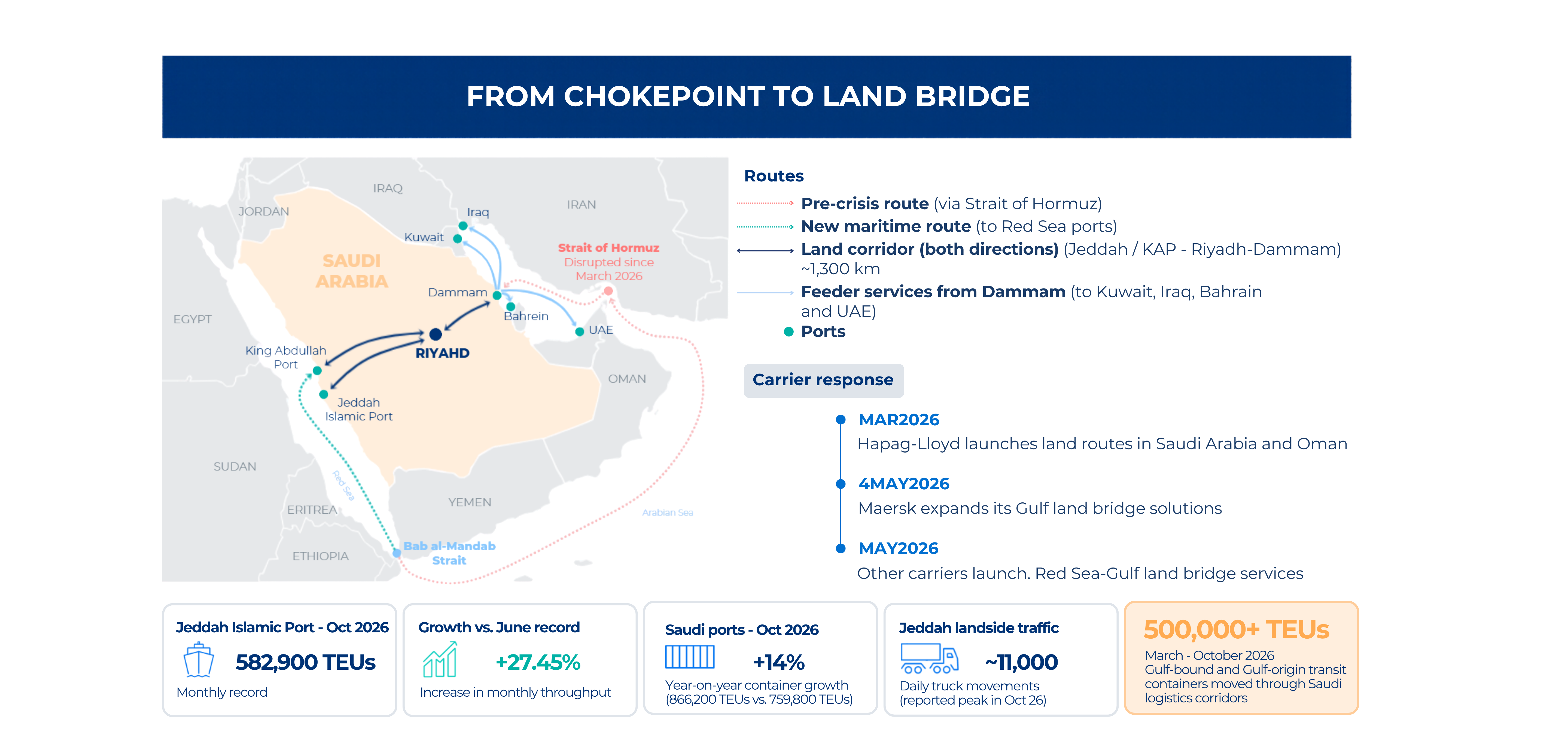
Earlier this year, in our previous blog, "Global Trade at Risk: Lessons from the Strait of Hormuz", we discussed how heavily global trade depends on a small number of maritime chokepoints, and how much of the system's efficiency rests on their continued availability. That risk materialized quickly. Following the closure of the Strait in March 2026, container trade bound for the Upper Gulf had to find alternative routes.
Jeddah Islamic Port, the leading container port on the Red Sea, emerged as one of the main gateways for cargo diverted from the Arabian Gulf following disruptions to shipping through the Strait of Hormuz. Alongside King Abdullah Port, Jeddah played a key role in accommodating alternative logistics corridors established by major shipping lines, including MSC, Hapag-Lloyd and Maersk, which redirected cargo through Red Sea ports for onward transportation by road to Saudi Arabia's Eastern Province and other Gulf markets.
While both ports benefited from these redirected flows, Jeddah experienced particularly significant pressure on its landside infrastructure. Container throughput reached a record 582,900 TEUs in October 2026, representing a 27.45% increase over its previous record set in June. This surge in container volumes placed considerable strain on port access roads, gates and surrounding logistics infrastructure, underscoring the critical importance of landside capacity, efficient traffic management and operational coordination in maintaining port efficiency and resilience.
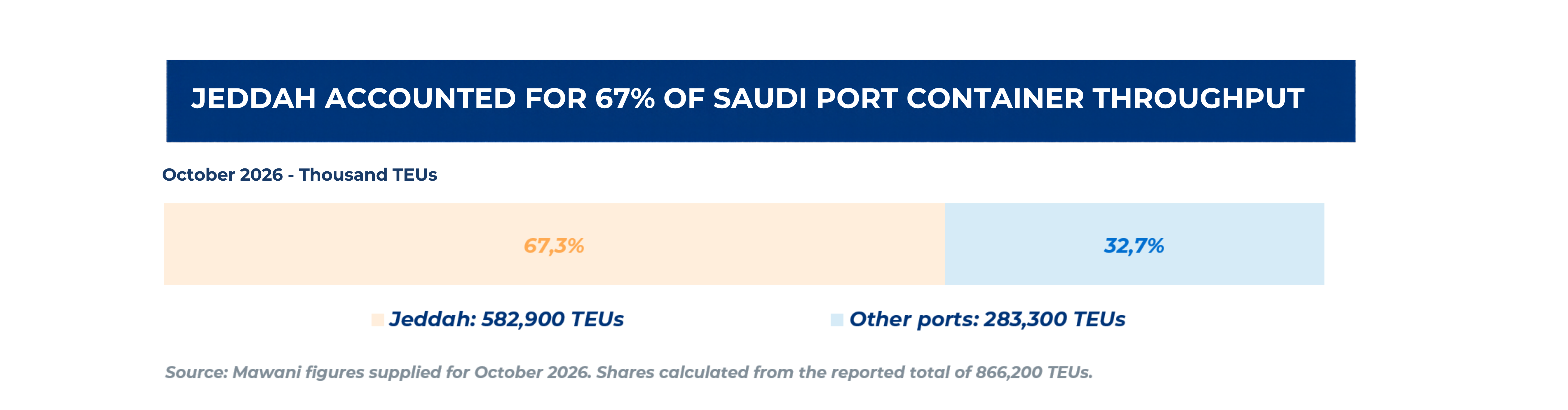
Jeddah handled approximately 67% of all container throughput across Saudi national ports in October 2026, reinforcing its importance as a national logistics gateway.
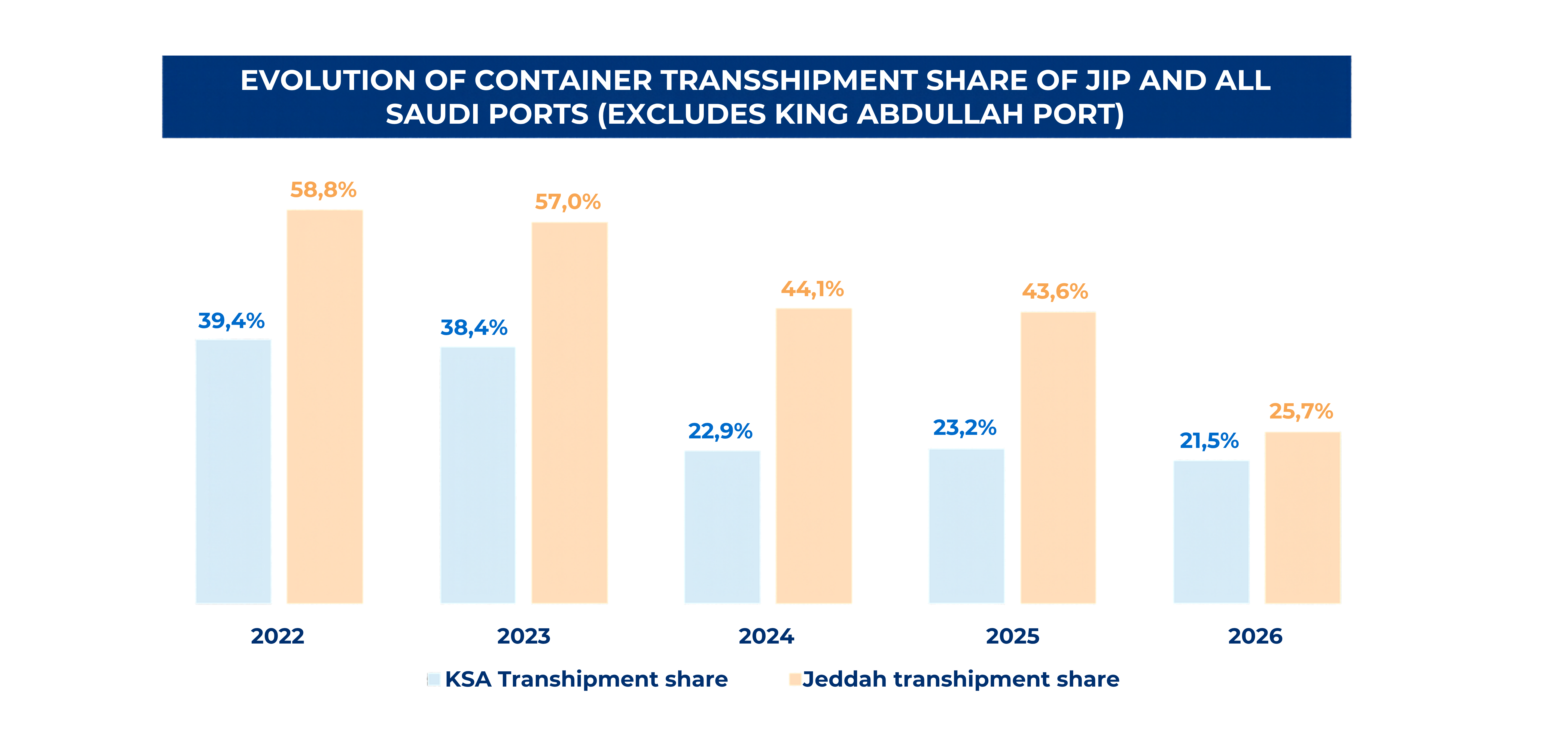
Jeddah Islamic Port has been shifting steadily from transshipment toward gateway cargo. Its transshipment share fell from 58.8% in 2022 to 43.6% in 2025, a drop of 15.2 percentage points, and then to 25.7% in July 2026. The sharpest part of this decline coincides with the land bridge: with Hormuz disrupted, Jeddah began serving markets traditionally supplied through Dammam on the Arabian Gulf, such as Riyadh, increasing the share of cargo that leaves the port by road rather than on another vessel.
The decline is also visible at national level, where the transshipment share of Saudi ports fell from 39.4% in 2022 to 21.5% in July 2026. Jeddah, however, has fallen considerably faster: the gap between the port and the national average has narrowed from 19.4 percentage points in 2022 to just 4.2 points in 2026, bringing Jeddah’s cargo profile much closer to that of the rest of the Kingdom.
When the bottleneck moves ashore
The consequences of these maritime disruptions extended well beyond Saudi Arabia, exposing the limitations of landside infrastructure across regional ports. At Khor Fakkan, on the UAE's east coast, weekly container throughput surged from approximately 8,000 to 65,000 TEUs, while daily truck movements increased from around 100 to 8,500. This dramatic shift from predominantly transshipment operations towards gateway cargo illustrates how quickly maritime disruptions can overwhelm landside infrastructure.
Jeddah Islamic Port faced a similar challenge. The rapid increase in container volumes, combined with the emergence of the Red Sea–Gulf land bridge, placed unprecedented pressure on its access roads, gates and internal traffic network. Truck traffic rose significantly compared with pre-crisis levels, reaching approximately 11,000 trucks per day by early November 2026. Congestion increasingly affected both port operations and the surrounding urban road network.
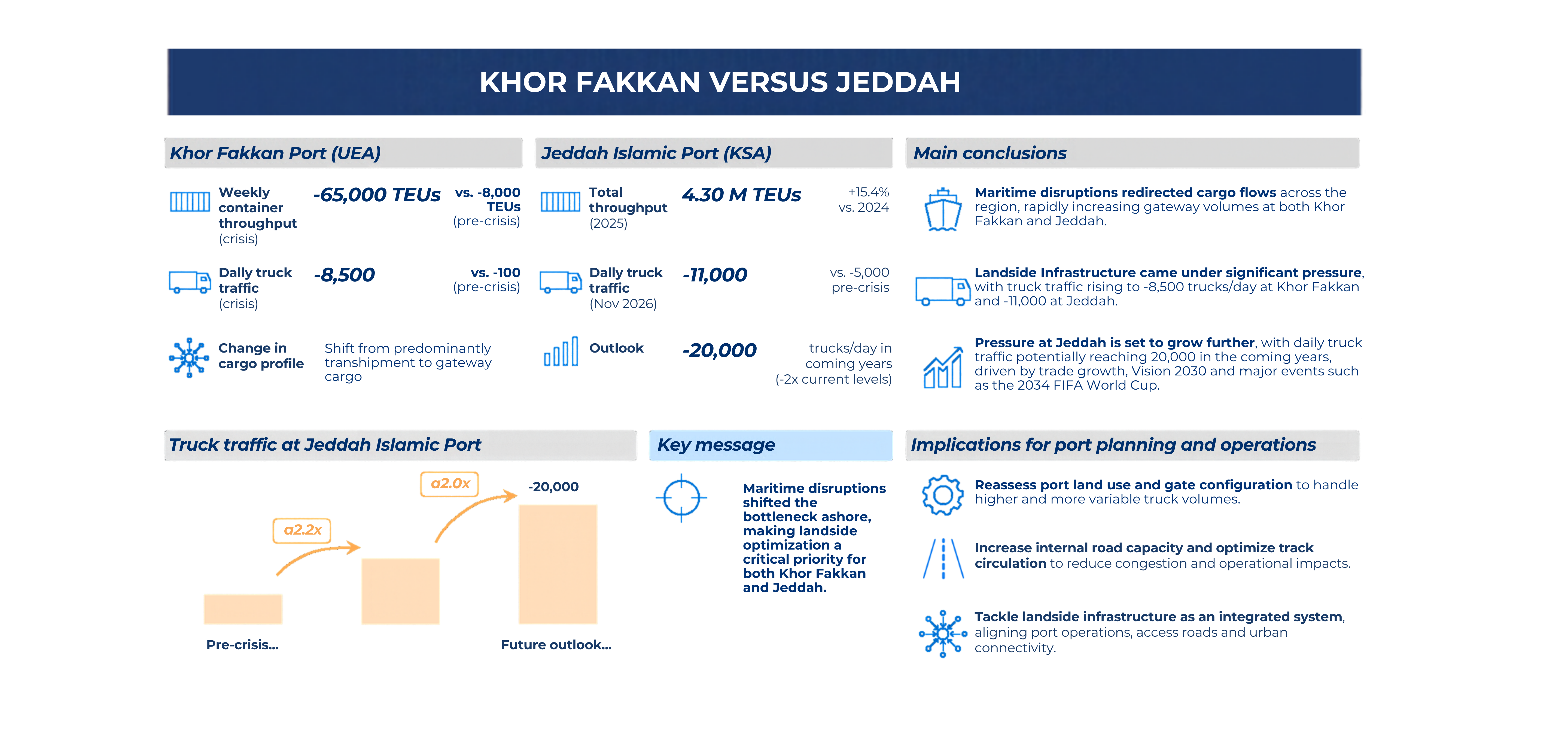
Looking ahead, the pressure on Jeddah's landside infrastructure is unlikely to ease. Driven by Saudi Vision 2030, growing trade volumes, major upcoming events such as the 2034 FIFA World Cup and continued geopolitical uncertainty, daily truck traffic could nearly double to approximately 20,000 trucks in the coming years. Accommodating this growth will require more than expanding infrastructure. It calls for a comprehensive reassessment of port land use, access gates, internal road capacity and truck circulation, ensuring that all elements of the landside system operate efficiently as an integrated network.
Why intuition is not enough at the gate
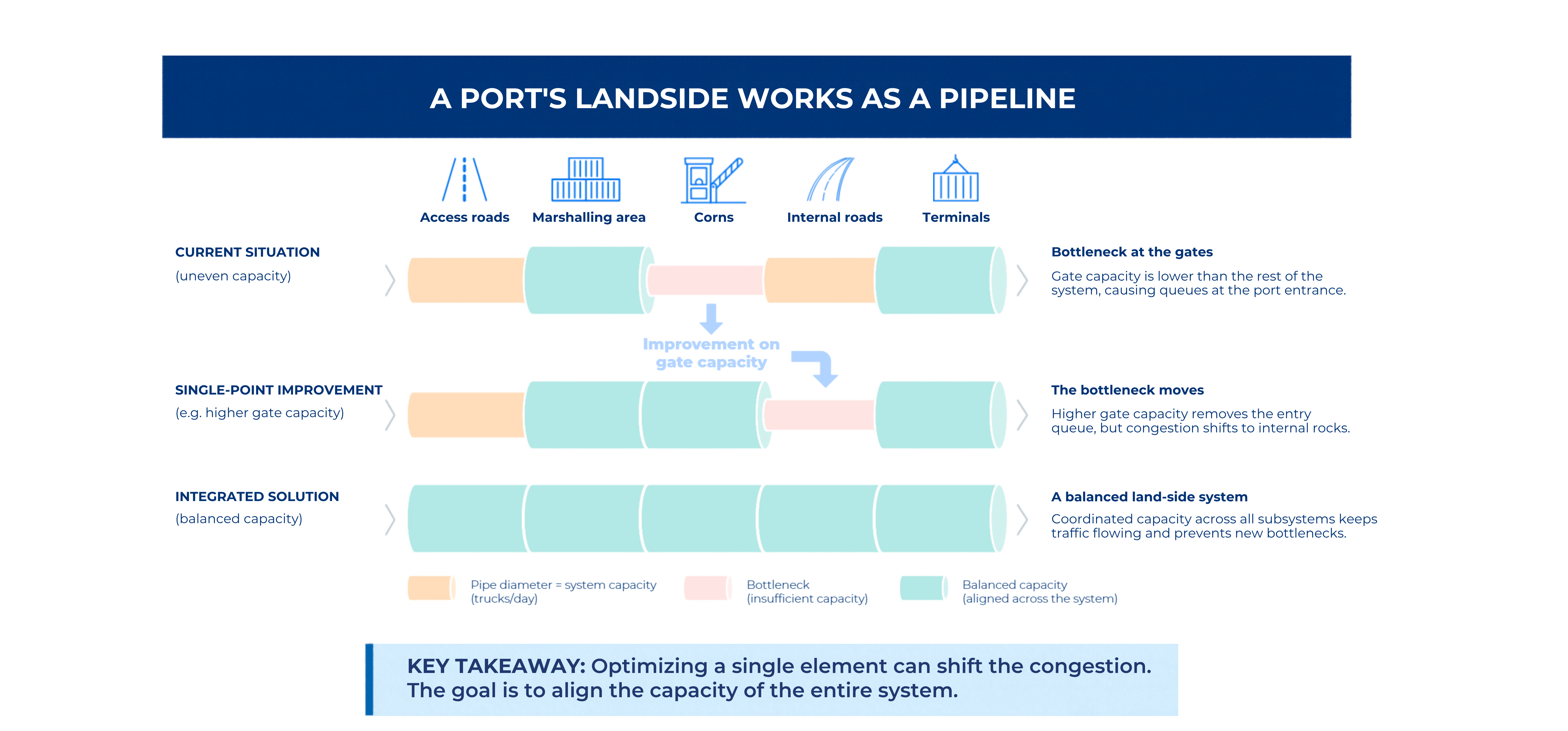
A port's landside infrastructure does not operate as a collection of independent assets. Access roads, marshalling areas, gates, internal roads and terminals form an interconnected system, managed by different stakeholders and exposed to fluctuating demand patterns. Improving the performance of one component does not necessarily improve the efficiency of the system as a whole.
For example, increasing gate processing capacity may reduce queues at the port entrance, but it can also push congestion further inside, onto internal roads or towards terminal access points, if downstream infrastructure cannot accommodate the additional traffic. Similarly, expanding truck marshalling capacity may improve traffic regulation outside the port without necessarily addressing bottlenecks elsewhere in the system. In an interconnected network, removing a bottleneck at one location can simply shift it to another.
Jeddah Islamic Port illustrates this challenge. In April 2026, a dedicated marshalling area covering more than one million square meters became operational to regulate truck arrivals before entering the port. While this facility provides an important buffer between external traffic and port operations, its effectiveness depends on how efficiently trucks can be processed through the gates and distributed across the internal road network and terminals.
The challenge, therefore, is not simply to increase infrastructure capacity, but to understand how the entire landside system responds to changes in traffic demand, operational rules and infrastructure configurations. This is where integrated traffic simulation becomes essential, allowing port authorities to identify bottlenecks, assess interactions between different subsystems and test alternative solutions before implementing them.
From bottlenecks to solutions: Simulating Jeddah's landside operations
To address these challenges, ALG's Maritime team has developed a port landside digital twin that replicates the operational behavior of interconnected port subsystems, identifies bottlenecks and evaluates improvement measures. Recently applied in a project for Mawani at Jeddah Islamic Port, the tool has supported the optimization of land use, truck circulation and access infrastructure under different demand scenarios.
The digital twin integrates the entire landside logistics chain, from access roads and marshalling areas to gates, internal circulation and terminals. Calibrated against actual operating conditions, it combines traffic demand forecasts with stochastic simulation techniques, including Monte Carlo analysis, to capture variability in truck arrivals, processing times and peak-hour demand. This allows ALG to anticipate where and when congestion is likely to develop and assess the performance of alternative configurations.
For Jeddah, more than 70 infrastructure and operational configurations were tested across demand scenarios ranging from approximately 10,500 to 20,000 trucks per day. These included alternative gate arrangements, circulation patterns and land use options, evaluated against indicators such as waiting times, queue lengths, throughput and infrastructure utilization.
The main advantage is the ability to test decisions before implementing them. For port authorities, this means optimizing infrastructure investments, land allocation and traffic management while avoiding costly interventions that simply shift congestion elsewhere. For terminal operators, it means shorter and more predictable truck turnaround times, improved terminal accessibility and fewer operational disruptions.
From strategic planning to predictive traffic management
As ports expand and cargo flows evolve, new terminals, logistics facilities and infrastructure developments continuously reshape traffic patterns. The digital twin allows these changes to be assessed in advance, including the impact of construction works, temporary road closures and alternative traffic arrangements.
At Jeddah, the analysis supported a phased roadmap of urgent, short-term and medium-term measures, combining operational improvements, gate and road reconfiguration, land use optimization and stronger coordination between port stakeholders.
The next step is to evolve the digital twin into a predictive traffic management platform. By integrating expected hourly truck demand, truck destinations and historical operating patterns, the model could anticipate congestion and recommend preventive measures, such as redirecting traffic to alternative gates, adjusting internal circulation or managing truck arrivals.
Connected to real-time monitoring systems, including traffic sensors, gate management platforms and vehicle tracking technologies, the digital twin could continuously update forecasts and support dynamic operational decisions. Achieving this requires effective data sharing between port authorities, terminal operators, trucking companies and other logistics stakeholders.
Ultimately, the opportunity is to move from reacting to congestion to anticipating and preventing it, transforming the digital twin into a decision-support tool for both long-term infrastructure planning and day-to-day port operations.
The next bottleneck may not be at sea
The Jeddah experience illustrates a broader lesson for the port industry: maritime connectivity is only as resilient as the landside infrastructure supporting it. As shipping networks adapt to geopolitical disruptions and evolving trade patterns, ports must be prepared not only to accommodate additional cargo volumes, but also to move them efficiently beyond the terminal.
Building this resilience does not necessarily mean building more infrastructure. It means making better use of existing capacity, anticipating future constraints and ensuring that access roads, gates, terminals and logistics facilities operate as an integrated system.
The ports best positioned for future disruptions will be those able to anticipate changing demand, test alternative solutions and adapt their operations before congestion takes hold.
In an increasingly unpredictable maritime environment, port competitiveness will depend not only on how much cargo a port can handle, but on how efficiently it can keep that cargo moving.
About the authors

Anna Díaz Llop
Msc in Civil Engineering (with specialization in port planning). Senior Engagement Manager at ALG.

Javier Ramos
MSc and BSc in Maritime Engineering, specialized in vessel dynamics and ship systems. Experience in global market analysis and commercial strategy within the maritime sector for numerous commodities. Consultant at ALG.


