

Latin America’s port sector is attracting an increasingly diverse group of investors. Terminal operators, industrial and logistics companies, infrastructure and financial investors, and shipping lines are all competing for access to terminal infrastructure, but recent transaction data suggests that they are not necessarily targeting the same assets or valuing them in the same way.
While all investors need to assess the standalone economics of a terminal asset, different buyer profiles may be able to capture additional sources of value depending on how the asset fits within their broader business model, network or supply chain. As a result, the attractiveness of a terminal (and the value different investors may be able to extract from it) can vary significantly from one buyer to another.
What recent transactions tell us
Our analysis of port transactions in Latin America over the past two years shows a clear difference between transaction activity and transaction value.
Industrial and logistics companies account for the highest number of transactions, with 21 deals representing approximately USD 10.6 billion. Terminal operators follow with 14 transactions and USD 1.7 billion in total value.
Shipping lines, however, have completed only eight transactions, but these represent approximately USD 23.7 billion, equivalent to a substantially higher average transaction value.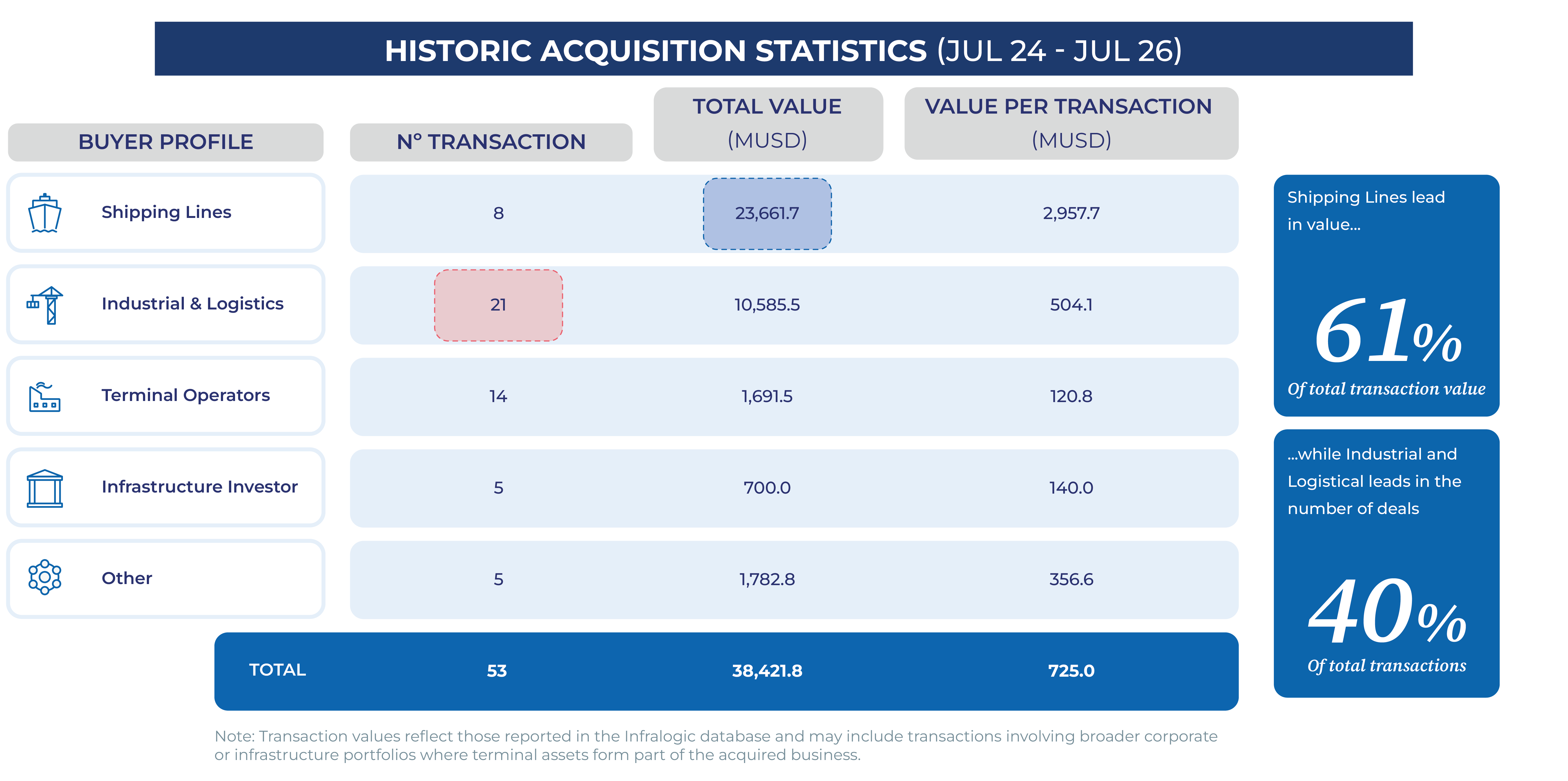
The significant difference in average transaction values raises an important question: Why might the same terminal asset have a different value for different types of buyers?
Standalone value and additional strategic value
A traditional infrastructure valuation typically focuses on the cash flows generated by the asset itself. EBITDA, concession life, CapEx requirements, throughput and tariff assumptions, operating costs, cost of capital and terminal or exit value all play a central role in determining the investment case.
For some buyers, however, the value of a terminal can extend beyond these standalone economics. The nature of this additional strategic value depends on the buyer’s business model and on how the asset fits within its wider network or supply chain.
For shipping lines and their affiliated terminal operators, this may include network, capacity and operational synergies. For industrial and logistics companies, it may come from greater control over cargo flows and supply chains. For terminal operators, value can also be created through operational expertise, customer relationships and portfolio synergies.
The standalone economics of the terminal therefore remain fundamental for any investor. What differs across buyer profiles is the extent to which additional value can be captured outside the terminal’s own P&L.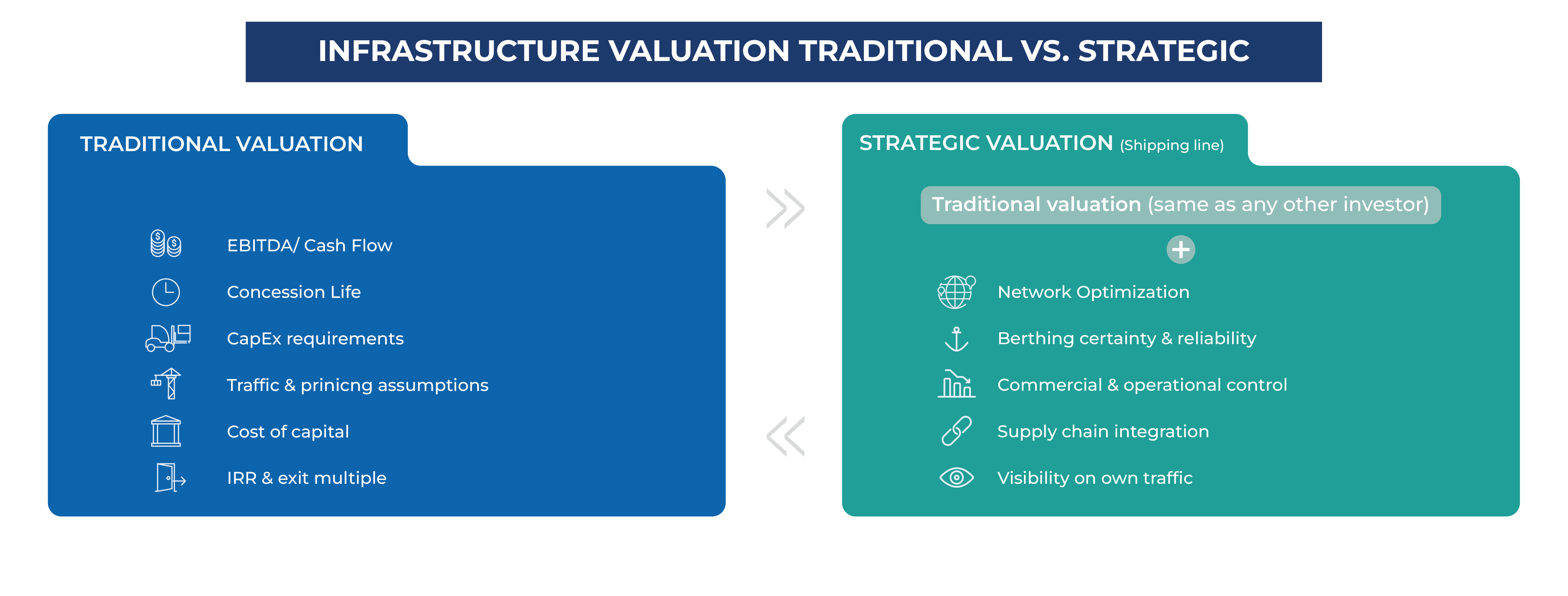 Shipping groups and their affiliated terminal operators provide a particularly clear illustration of this dynamic.
The link between infrastructure and demand
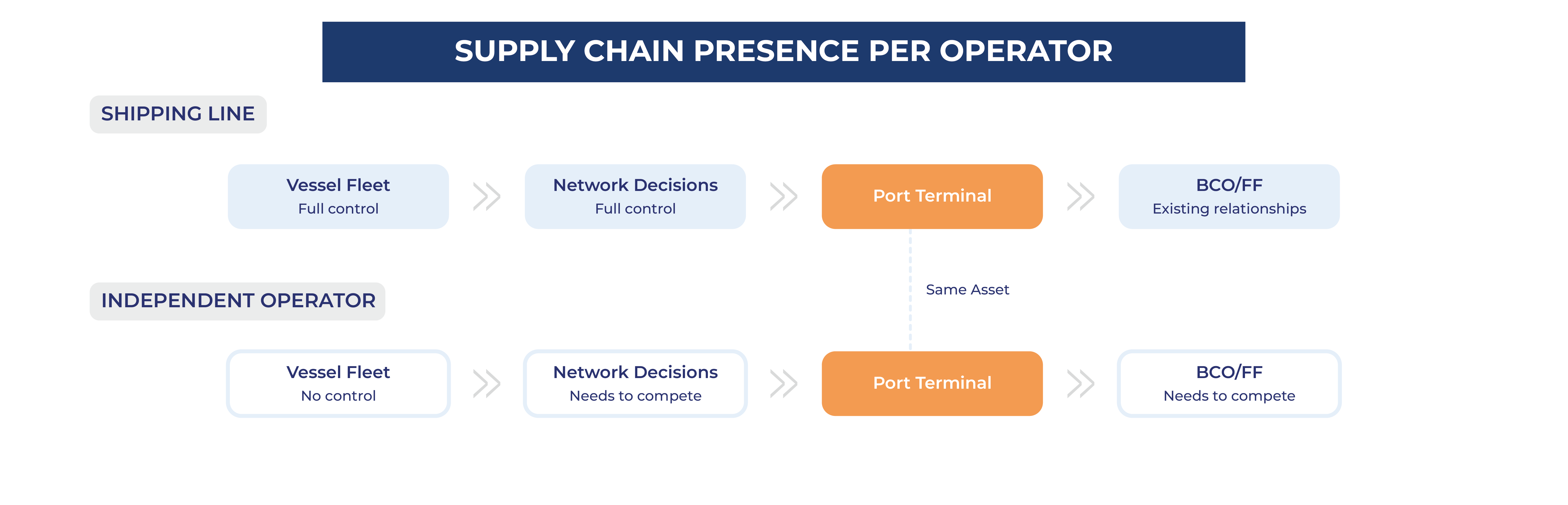
One of the key differences between an independent terminal operator and a vertically integrated shipping group is their relationship with demand.
An independent operator acquiring a container terminal generally needs to attract shipping lines, negotiate services and compete for vessel calls and associated cargo volumes, particularly in highly competitive markets.
A vertically integrated shipping group already controls part of this ecosystem. It operates vessels across established trade routes and has existing commercial relationships with cargo owners and customers. A terminal integrated into that network may therefore have greater visibility over part of its future demand and may benefit from closer coordination between vessels, terminal capacity and inland logistics.
Greater berth availability and operational reliability can also contribute to shorter vessel turnaround times and more predictable services. These benefits may ultimately translate into lower costs, higher revenues, improved service reliability and stronger customer retention across the wider network.
However, this strategic value is not inherent to every terminal. It depends on the asset’s location, capacity, congestion levels, hinterland connectivity, cargo mix and concession structure, as well as on the buyer’s existing network.
A terminal that is highly strategic for one shipping group may therefore offer considerably less incremental value to another.
What does vertical integration mean for independent terminal operators?
The increasing presence of shipping groups in terminal ownership also raises an important question for independent operators: Can an independent terminal operator remain competitive as vertical integration increases? The answer depends largely on market structure.
In a port with one dominant terminal, or where a small number of shipping lines represent a significant share of demand, an independent operator may face a structural disadvantage. A vertically integrated shipping group with an affiliated terminal network may have greater ability to coordinate routing decisions, terminal allocation and cargo flows across its network.
This can become particularly relevant where carriers have access to alternative terminals within the same region, since the ability to redirect vessels or volumes can provide additional bargaining power.
In a multi-terminal port, however, independence can also become an advantage. A neutral operator can serve competing shipping lines without being directly linked to one carrier’s network. This may make the terminal attractive to carriers that prefer not to concentrate their volumes in a competitor-affiliated facility.
Rather than competing with vertically integrated groups on network scale, independent operators can create value through neutrality, operational performance, customer diversification and reliability.Vertical integration is therefore not inherently positive or negative. Its value, and its competitive impact, depends on the structure of the market in which the terminal operates.
Vertical integration is therefore not inherently positive or negative. Its value, and its competitive impact, depends on the structure of the market in which the terminal operates.
Different buyers, different sources of value
- Carrier-affiliated terminal operators may value terminals for their contribution to network optimisation, capacity security and operational integration.
- Industrial and logistics companies may place greater value on control over cargo flows, logistics interfaces and critical supply-chain nodes.
- Independent terminal operators can create value through operational expertise, customer relationships, regional scale and portfolio synergies, while neutrality may itself become a competitive advantage in certain multi-terminal markets.
- Infrastructure and financial investors, whose role in the sector is becoming increasingly relevant, may focus more strongly on long-term cash-flow generation, concession frameworks and the standalone risk-return profile of the asset, while also pursuing platform and portfolio strategies.
Beyond the standalone value
The evolution of terminal ownership in Latin America is unlikely to result in a market dominated by a single type of investor. Different ownership models can coexist, with each creating value in different ways.
The key question is therefore not simply how much a terminal is worth on a standalone basis, but how much additional value different buyers may be able to capture from it.
As vertical integration and investor diversification continue to reshape the sector, understanding these different sources of value will become increasingly important for investors and terminal owners assessing future transactions and competitive dynamics.
About the authors

Javier Ramos
MSc and BSc in Maritime Engineering, specialized in vessel dynamics and ship systems. Experience in global market analysis and commercial strategy within the maritime sector for numerous commodities. Consultant at ALG.

Manuel Hernández
Bsc. Civil engineering specialized in transport and urban services and Msc. Civil engineering specialized in infrastructure financing. Team Leader at ALG.

Ignacio Rodríguez de la Rúa
MSc and BSc in Civil Engineering. His areas of expertise include PPP structuring, the definition of strategic and commercial guidelines, business development, M&A advisory and others worldwide, all within the maritime sector. Senior Engagement Manager at ALG.


