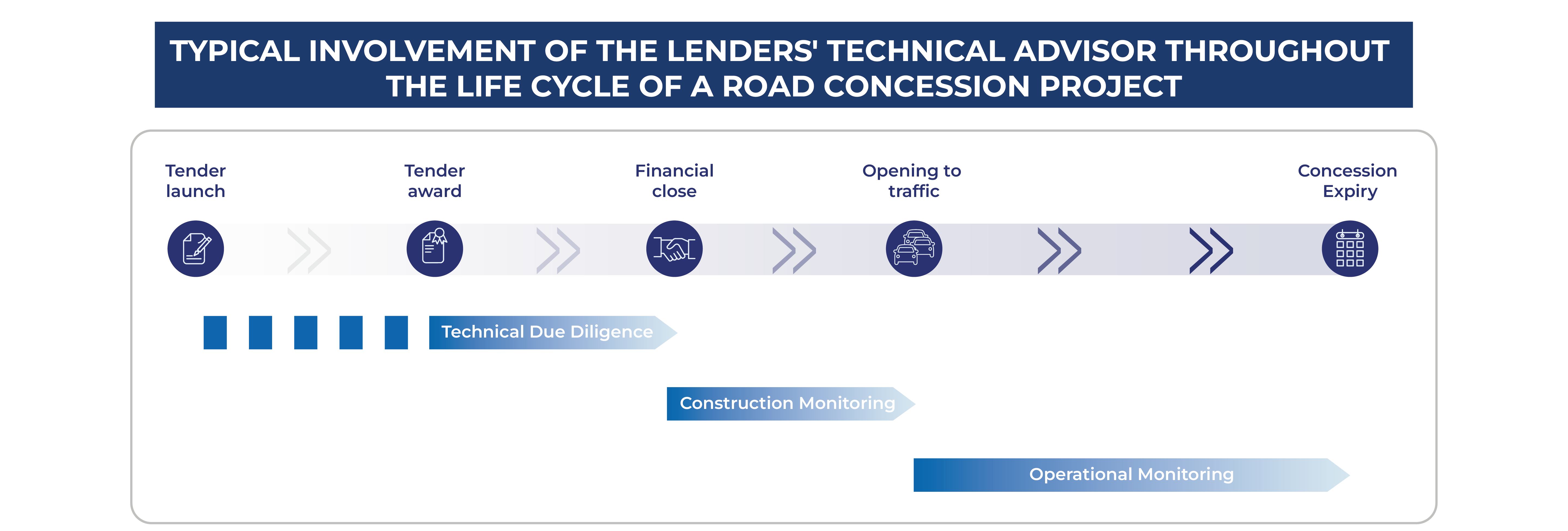
The scope of a Lenders' Technical Advisor is best understood as a continuum rather than a single assignment. While lender advisory services are often associated with the technical due diligence carried out before. Financial Close, in practice the advisor's involvement may begin at different stages of the project depending on the procurement process, financing structure and the specific needs of the lenders.
In most PPP and concession projects, lenders appoint the Technical Advisor once a Preferred Bidder has been selected and financing negotiations commence. At this stage, the focus is on assessing the technical, traffic and ESG assumptions underpinning the financing structure before debt is committed.
However, in some projects, particularly those involving substantial financing requirements, the advisory team may become involved earlier, during the procurement phase. Early engagement allows lenders to review the tender documentation, identify potential bankability issues and anticipate technical or environmental risks before the project reaches Financial Close.
Following Financial Close, the advisor's role naturally evolves from due diligence to independent monitoring. The emphasis shifts from assessing assumptions to verifying that the project is being delivered and operated in accordance with the expectations established during the financing process. Technical monitoring, traffic performance reviews and ESG oversight therefore become complementary activities aimed at protecting the long-term value of the investment.
Building confidence before financial close
The objective of lender due diligence is not to redesign the project or challenge every engineering decision made by the sponsor. Instead, it is to determine whether the technical, contractual, operational and environmental assumptions supporting the financing are sufficiently robust for long-term debt investment. Ultimately, the due diligence process provides lenders with an independent assessment of project bankability.
The technical due diligence therefore becomes a key component of the financing process. Rather than re-designing the project, the objective is to evaluate whether the proposed solution is sufficiently mature, technically sound and capable of being delivered within the planned schedule and budget.

An important aspect of the LTA's work is independence. Rather than representing either the project sponsors or the contractors, the advisor provides lenders with an unbiased technical opinion, allowing financing decisions to be based on objective evidence rather than solely on sponsor assumptions.
The ultimate objective is to provide lenders with independent assurance that the project is being developed and delivered in accordance with a robust technical strategy, with the appropriate actions, planning and controls in place to support successful construction and long-term operational performance.
Independent monitoring during construction
Financial close does not mark the end of the Lenders' Technical Advisor's role; rather, it marks the beginning of an independent monitoring process that continues throughout the construction phase until commercial operation.
During construction, lenders require assurance that technical, financial and contractual risks remain under control, that works are progressing according to schedule and that debt drawdowns accurately reflect the physical progress achieved on site.
This oversight is primarily delivered through periodic site visits, complemented by regular reviews of project documentation, construction reports and meetings with sponsors, EPC contractors and relevant project stakeholders. These site inspections enable the LTA to verify actual progress, identify emerging risks at an early stage and independently validate the information reported by the project company.

Following each monitoring visit, the LTA issues an independent report summarising project status, identifying key risks and highlighting any issues that may affect schedule, budget or future operations. These reviews are typically carried out on a quarterly or semi-annual basis, although the frequency may be adjusted to reflect the project's specific requirements.
In many projects, the advisor also supports lenders by certifying construction progress for debt drawdowns, confirming that the contractual milestones and technical conditions required for each disbursement have been satisfied. Depending on the financing arrangements, these certifications are commonly issued on a monthly basis.
This continuous monitoring process enables lenders to identify potential schedule delays, cost overruns or technical issues before they materially affect the project's financial performance, allowing corrective actions to be implemented at an early stage.
Operational monitoring: protecting long-term asset performance
Once the infrastructure enters operation, the nature of project risk changes significantly. Construction risk is replaced by operational, maintenance and asset performance risks, all of which ultimately influence the project's long-term cash generation capacity.
Independent operational monitoring is essential for lenders to ensure that the asset continues to perform as expected throughout the concession period.

Beyond verifying contractual compliance, operational monitoring assesses whether maintenance strategies remain adequate to preserve the long-term value of the asset and avoid the accumulation of deferred maintenance liabilities that could compromise future cash flows.
From a lender's perspective, protecting asset quality is ultimately equivalent to protecting repayment capacity. Independent monitoring therefore provides continuous assurance that technical performance remains aligned with the assumptions supporting the original financing.
Creating value through independent technical oversight
The role of the Lenders' Technical Advisor extends well beyond identifying technical deficiencies. Independent advisory services contribute to better-informed financing decisions by improving transparency, reducing information asymmetries and facilitating constructive dialogue between lenders, sponsors and contractors.
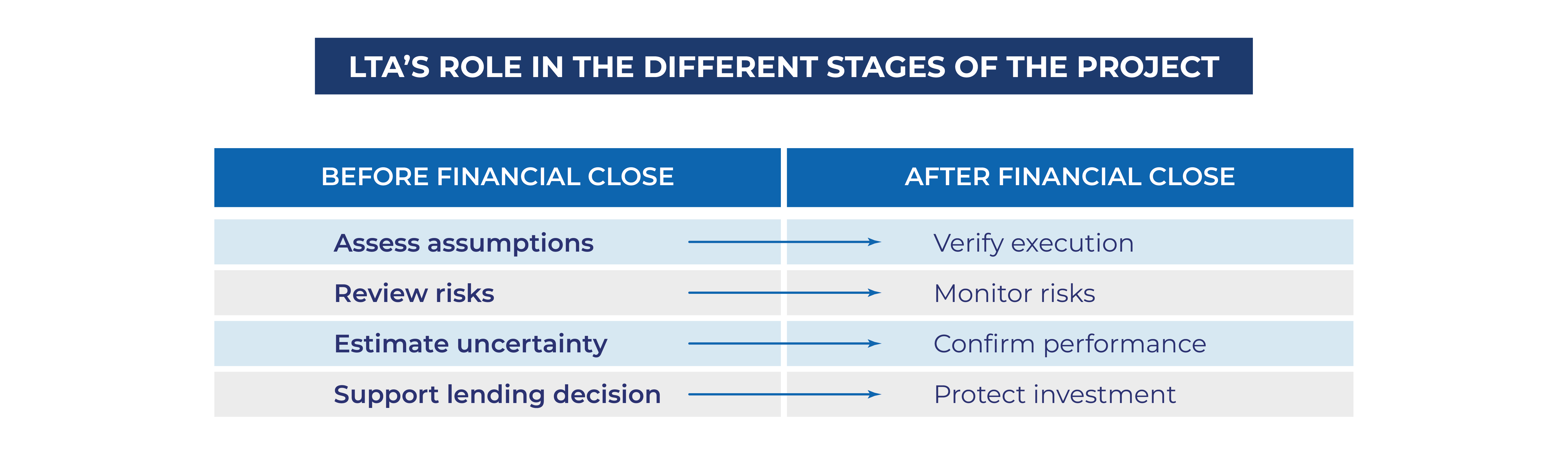
An experienced technical advisor provides confidence that project risks are being appropriately managed throughout the investment lifecycle, from financial close to concession expiry.
This independent perspective becomes particularly valuable in today's infrastructure market, where projects are increasingly complex, financing structures are more sophisticated, and investors place greater emphasis on resilience, sustainability and long-term asset performance.
About the authors

Cesar Valero
Civil Engineer with an MSc and an MBA. Specialist in transport infrastructure with over 30 years of experience in highways, urban mobility, and rail. Experienced in both public and private sectors, focusing on sustainable transportation, transaction advisory, strategic development, and feasibility studies. Partner at ALG.