On the night of the round of 32 match between Mexico and Ecuador, I had to get out of the van well before reaching the stadium and walk thirty minutes through a restricted pedestrian walkway to the entrance. On the way back, in the early hours of the morning, the ritual was repeated in reverse: another thirty minutes on foot and a slow, congested journey, even though the match had ended almost two hours earlier. None of this was improvised: it was part of a carefully designed mobility plan. And yet, there I was, first walking and then stuck in traffic. That scene encapsulates a paradox that goes far beyond a football match. It also reflects the daily reality of traffic congestion in many of the world’s largest cities, where moving millions of people efficiently remains one of the greatest urban mobility challenges.
An operation that almost worked
For the 2026 World Cup, Mexico City deployed an ambitious mobility strategy: new electromobility corridors, infrastructure modernization, and a "last mile" logistics operation around the stadium.
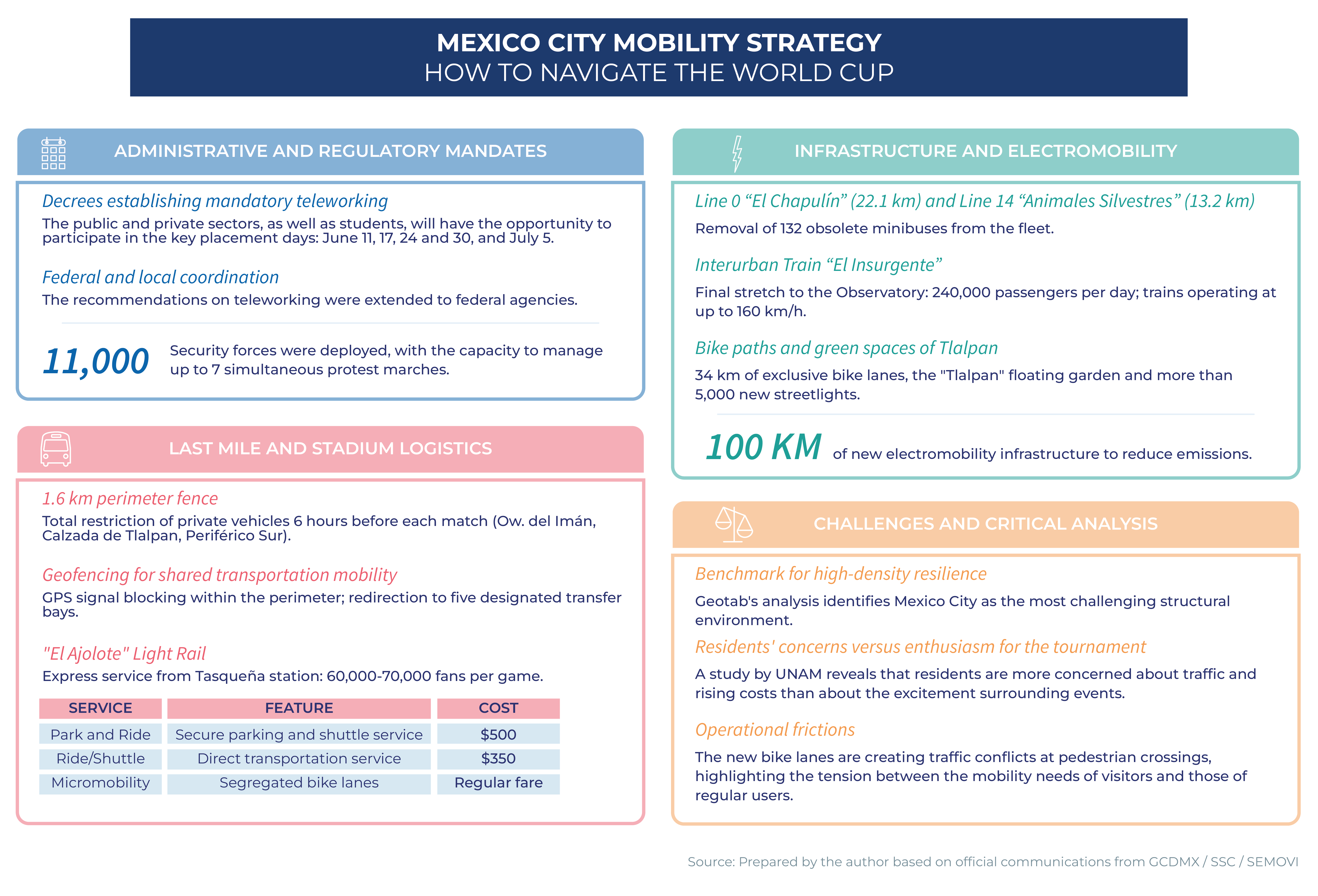
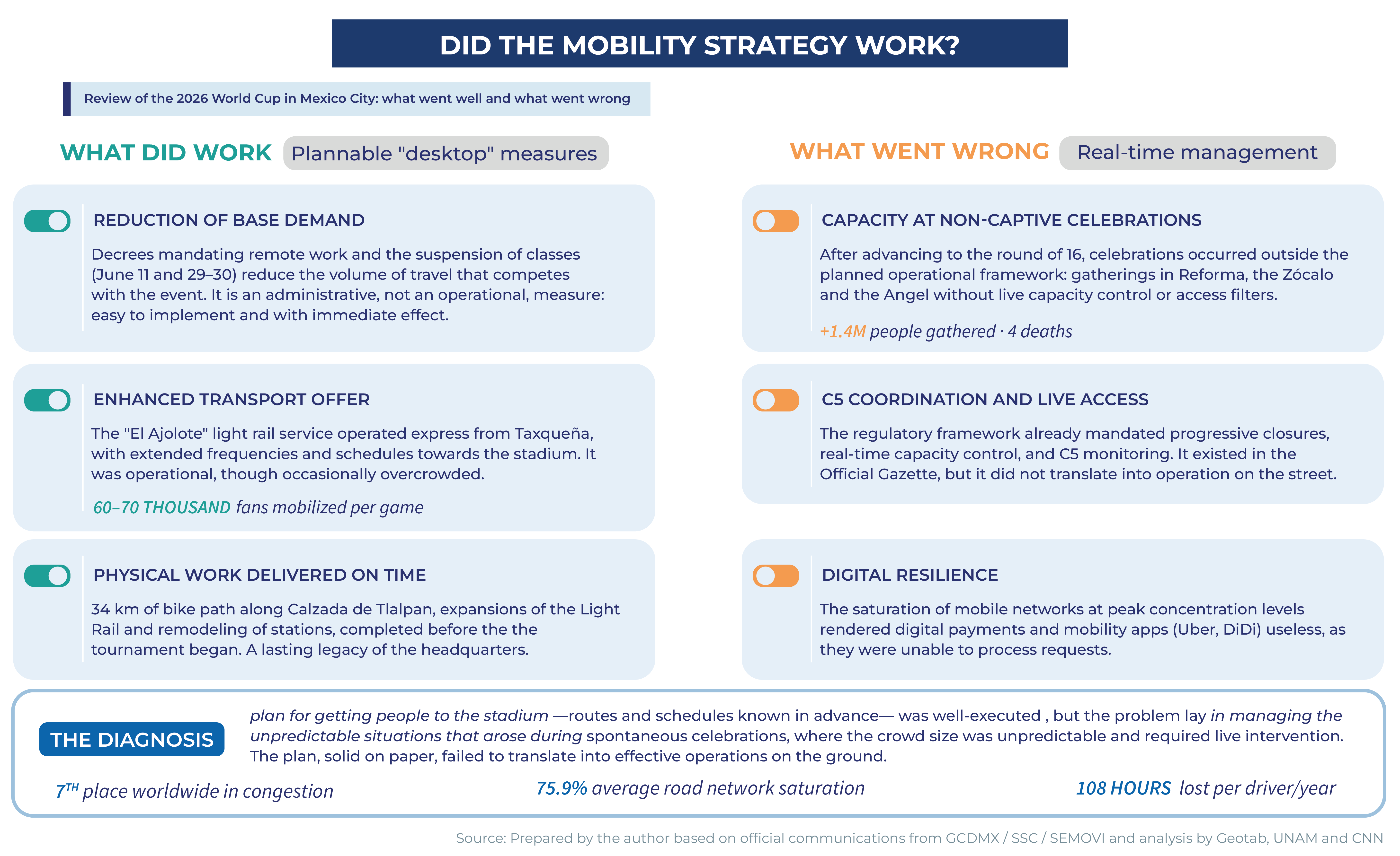
The relevant question is: did it work? The honest answer is “partially”, and that distinction is crucial. Almost everything that could be planned from the office worked: the remote work, the scheduled reinforcement of transportation to the stadium, and the construction work completed on time. What failed, however, was what depended on real-time operation: managing capacity when the crowds deviated from the plan (the celebrations after advancing to the round of 16 drew over a million people, with tragic consequences) live access control, and even digital resilience, when mobile network overload crashed payments and applications. In short: getting people to the stadium was handled well, but managing them when they stopped following the plan was a different story.
That distinction (what can be planned versus what happens in real time) is the first clue as to why traffic defeats cities that try to do things right. And a World Cup is nothing more than the acute version of a chronic illness that these cities suffer from daily.
Congestion is a drag on competitiveness
We tend to treat congestion as an inconvenience when it's actually an economic drain. Mexico City ranks seventh in the world, with an average congestion rate of nearly 76% and some 108 hours lost per driver per year; a figure comparable to that of Istanbul or Chicago, where the cost is estimated in the billions of dollars annually. Added up, this amounts to tens of billions of dollars per country: lost work time, wasted fuel, and goods that don't arrive. Reframed in this way, mobility ceases to be a matter of quality of life and becomes one of competitiveness. And the first question in a good diagnosis isn't "How much does it cost to act?" but rather "How much does it cost us to do nothing?".
Why building more doesn't work
Intuition dictates construction: more lanes, more elevated highways. Evidence stubbornly points in the opposite direction. Between 1950 and 2020, the global road network expanded from 8 million to over 64 million kilometers, but the vehicle fleet exceeded 1.5 billion units and is projected to reach 2 billion by 2040, at a rate that doubles the expansion of road capacity. This phenomenon is called induced demand: each new lane fills up within a few years. You can't pave the way out of congestion, just as you can't lose weight by loosening your belt.
If building isn't enough, what is? For a century, we optimized two layers: supply (building) and planning (programming), and both have been exhausted. The untapped lever is another, and uncomfortable one: reclaiming space. The 20th-century city gave the automobile its most valuable asset (public land) for free. Reclaiming it, in four dimensions, is the next frontier.
First step: prevent the trip
The most efficient journey is the one that doesn't happen. The "15-minute city", every essential service a 15-minute walk or bike ride away, is sold as a green idea, but it's a marketing blunder: it's the only measure that addresses demand at its source. Paris and Barcelona aim to reduce the need for travel by 15–20% through mixed-use development; in a megacity, that surpasses any colossal construction project. And it's also a real estate proposition: mixed-use development increases land value, which connects it to how all of this is financed.
Second move: reassign the street
No city has reduced its traffic with carrots alone; the stick is necessary. The formula backed by evidence is push-pull: making public transport desirable and private cars, deliberately, less attractive. On the stick side, congestion pricing is the most effective instrument: London reduced cars in its city center by nearly 39%; Singapore charges dynamically, in real time. On the carrot side, the secret isn't lowering fares but making public transport reliable: people don't abandon their cars because the subway is free, but because it's predictable and much faster. And there's a Latin American taboo to address: cars are status symbols, and public transport carries a class stigma. The real work is one of perception: making it "what those who are smart with their time use".
And we routinely tolerate an aberration: parking on the street. A car spends 23 out of every 24 hours stopped, occupying the most expensive square meter of space in the city for free. Taking it off the road, to off-street parking and, above all, to dynamic car sharing, where one car replaces between ten and thirteen private ones, frees up an entire lane for what adds value. Furthermore, managing the "curbside parking", bays that change function by the hour and are reserved via an app, tackles "congestion traffic", which accounts for up to 40% of downtown traffic: cars circling, looking for a place to park.
Third movement: return the surface (with the limit of the subsoil)
Here, surgical precision is key, because "tunnel" masks two opposing ideas. The bad tunnel buries the ground to cram in more cars—induced demand with a luxury price tag. The good tunnel buries through traffic to return the surface to people: Madrid buried an eight-lane highway to create a linear park, and Seoul demolished the Cheonggyecheon elevated highway, reclaimed the river, and traffic didn't worsen: it vanished. The rule: a tunnel is only worthwhile if you put people, not more cars, on the surface it frees up. But Mexico City runs up against a geological barrier: the basin sits atop the ancient Lake Texcoco (water-saturated clays) and sinks several centimeters a year. Excavating here is slow, extremely expensive, and risky. Where the geology allows it, tunnels are built underground; where they don't—a good part of this valley—you have to look upwards.
Fourth movement: going through the air
The fourth dimension is the only layer that remains empty and free: the sky. The urban cable car has a rare elegance—it rests on a few poles and everything else floats, without touching the ground or subsoil. And here, Latin America is a world leader: Medellín made it a symbol of social reintegration in 2004, La Paz operates the largest cable car network on the planet, and Mexico City itself already has its Cablebús, which has cut commutes from an hour to twenty minutes. It costs a fraction of the metro fare, is built in a couple of years, is electric, and conquers impossible topography—ravines, hillsides, the steep periphery where those most dependent on transportation live. It is a measure of both fluidity and equity.
The missing layer: real-time intelligence
Having reclaimed the space, what's missing is what the World Cup laid bare: live operation. The best infrastructure is of little use if no one orchestrates it minute by minute. Adaptive traffic lights with AI reduce delays by up to 20% at intersections without civil works; digital twins simulate an incident before it happens; MaaS integrates metro, bus, bike, and taxi into a single app. The disruptive idea: the city improvised a control tower for the World Cup (for closures, traffic volume, last mile delivery) and will dismantle it afterward. But a megacity experiences a traffic-driven World Cup every Monday at eight o'clock. That capacity, a "traffic C5" that integrates data from traffic lights, public transportation, apps, and phone companies, shouldn't last six weeks every four years, but rather 365 days a year.
Three mirages… and a clever use of the sky
It's worth debunking three mirages being sold as silver bullets: it's not that they're useless, they're just correct answers to the wrong question. Cheap tunnels like the Boring Company move a few thousand passengers per hour compared to the 50,000 a subway can handle. Autonomous drones promise capacity but unleash a "rebound effect"—the induced demand of new clothes—: they lower travel costs but also increase mileage. And passenger eVTOLs are an engineering reality confined to a premium niche. The exception that is short-term and actually takes travel off the road is logistics drones: not for moving people, but for critical, lightweight, and high-value items—medicines, documents, samples. Last-mile delivery accounts for 53% of distribution costs, and sending it by air doesn't compete for space: it eliminates it. It's available today, not in 2040.
The climax: who pays for all this?
This is where most articles give up. Everything mentioned above is just wishful thinking until we answer the million-dollar question, and the answer is counterintuitive: the money is already being paid. Congestion isn't a cost to add to the budget; it's one the city is already spending (in hours, fuel, accidents, healthcare, and free land) without receiving anything in return. The task isn't to acquire the money, but to free up the money already trapped in traffic.
And the same measures that reduce car use generate the revenue that funds the alternative. The congestion charge isn't a tax: in London, it raises hundreds of millions annually, earmarked for transport. Parking reform transforms free space into revenue. And the most powerful lever is capturing land value: when a cable car or a park built over an underground motorway, increasing land value, capturing a portion of that increase means the project is paid for with the value it itself creates.
The sophistication lies not in the funding sources themselves, but in the circuits that link them—circuits that no government designs alone. The stick finances the carrot (with dynamic pricing, so that revenue doesn't fall when the measure is working); the value finances the infrastructure; the same "virtuous circle" I described for airspace, now on the ground; the savings are recycled into less maintenance and faster buses; and the public dividend politicizes the reform: refunding the fare or labeling it visibly, like Stockholm, which approved its fare collection by referendum after a trial. The financial design is, at its core, the design for political survival. All of this follows a sequence: the digital and operational aspects cost tens of millions and are quickly self-financing; transportation, hundreds of millions; the structural aspects, thousands over ten years. It starts with the smart traffic light that pays for the next step, not with the subway.
The role of a strategic and technological consultancy like ALG
There is no silver bullet: there is a systemic orchestration of physical, digital, financial, and regulatory measures, sustained over time and backed by the political courage to reform what is inconvenient. And this orchestration crosses finance, data, regulation, real estate, logistics, and politics; no one within a government has all those hands at once.
That's where a strategic and technology consulting firm adds value from several angles: it diagnoses with digital twins and accessibility indices and quantifies the cost of inaction; it plans by integrating territory, technology, and behavior; it prioritizes by separating quick wins from complex infrastructure; it orchestrates the ecosystem (MaaS, pricing, public-private partnerships); it designs the resilience (redundancy and protocols) that prevents collapse in the face of the next downpour; and, above all, it builds the financial architecture: it quantifies the return, designs the revenue streams, wires the circuits, sequences the CAPEX and OPEX, and makes the blow survivable. This repositions a firm like ALG not as a construction company or a provider of technological architecture, but as the conductor of the orchestra: the one who connects the dots within the government that lives in secretariats that rarely speak to each other.
Because the ultimate goal fits perfectly into the anecdote I started with: to make getting home no longer a walk in the dark and a midnight traffic jam, but simply a journey again. We know how to achieve it; the technology exists, and so does the money: it's there, trapped in traffic, waiting for someone with the vision and the method to free it.