Roads remain the most crucial logistical infrastructure for economic growth in the 21st century. Unlike railways, ports, or airports—whose efficiency depends on specific hubs—road networks offer virtually unlimited reach: they connect all regions, enable almost all markets, and allow the movement of any goods with complete flexibility in scheduling and operational redundancy.
Studies by the World Road Association (PIARC), the World Bank, and the OECD confirm that investment in road infrastructure has the highest economic multiplier among all modes of transport, especially in countries highly dependent on road transport. The correlation between kilometers of road network per capita and GDP per capita is clear and robust at all stages of development.
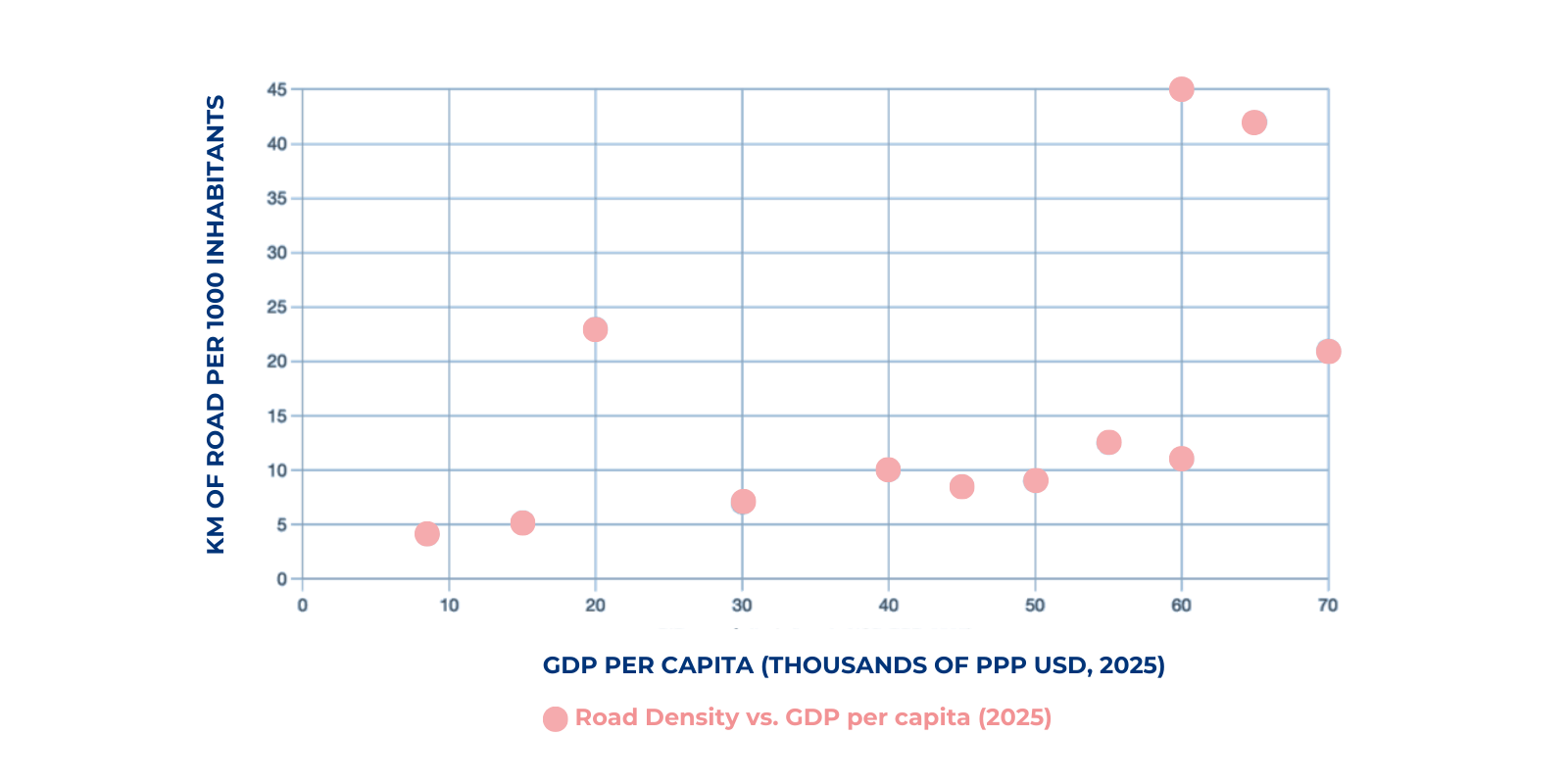
Advanced economies (the US, Canada, Western Europe, Japan, South Korea, and Australia) have consolidated dense, high-quality networks since the mid-20th century. Rapidly growing emerging economies (China, India, Brazil, Mexico, Turkey, and Indonesia) are expanding their networks quickly, but at a slower pace than motorization and urbanization. Lower-income countries continue to have inadequate networks that limit access to markets and services.
The global challenge is no longer just extending the network, but ensuring that the existing infrastructure maintains a minimum acceptable service speed, avoids chronic congestion, and offers adequate levels of security in a context of increasing demand and operational uncertainty.
The growth of the road network is insufficient with the current model
Between 1950 and 2020, the global road network grew from less than 8 million kilometers to more than 64 million kilometers. However, the global vehicle fleet exceeded 1.5 billion units in 2024 and is projected to reach 2 billion before 2040. In most emerging countries and in many metropolitan areas of developed countries, vehicle growth is two or three times faster than the rate of road capacity expansion.
This imbalance generates the well-documented phenomenon of demand induction: new roads or expansions tend to become full within a few years. Therefore, international evidence is conclusive: chronic congestion cannot be eliminated simply by building more kilometers of road. The solution must combine technological, operational, regulatory, and financial measures.
Complementary solutions with proven effectiveness
Any expansion or new infrastructure is much more effective when accompanied by measures that preserve the minimum operating speed. Some techniques have proven effective in maintaining average speeds of 70-80 km/h on urban highways and 90-110 km/h on interurban highways.
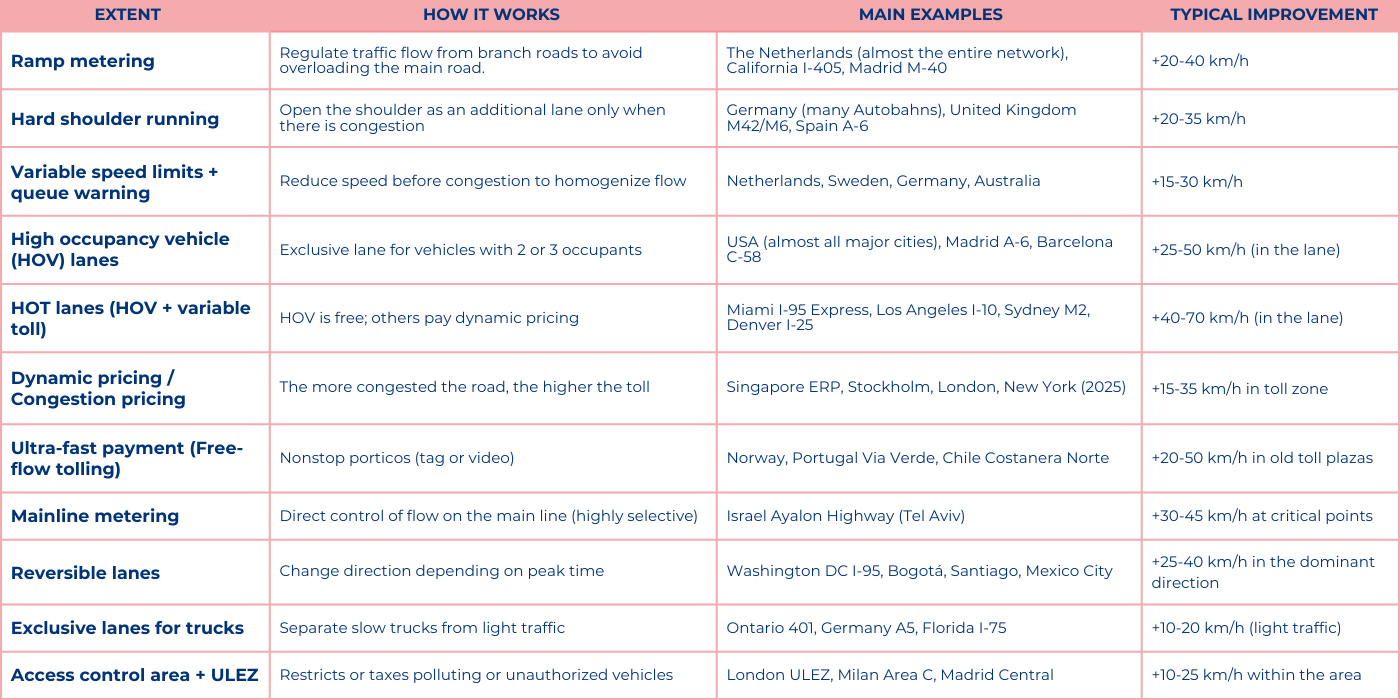
Any optimal solution typically combines 5-7 of these measures. Successful examples include Singapore (ERP + free-flow + ramp metering + variable limits + reversible lanes), the Netherlands (ramp metering + hard shoulder + variable limits + queue warning), and Southern California (hot lanes + ramp metering + free-flow + variable limits), among others.
A sustainable financial scheme: turning smart tolling into an engine for systemic improvement
Tolls allow for the financing of works that would not otherwise exist, but "extra payment" mechanisms within these infrastructures or on public roads, when properly applied, can trigger a virtuous cycle that benefits the entire network.
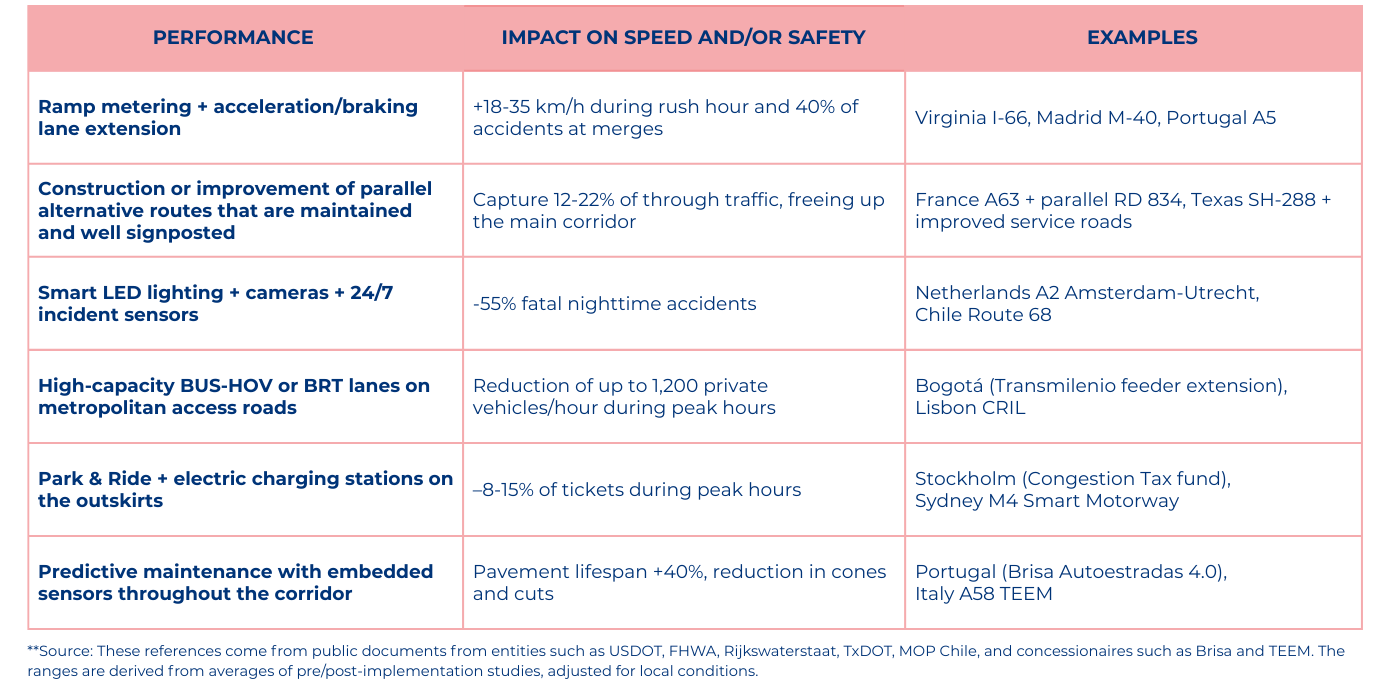
The model being successfully adopted by the most advanced countries and concessionaires (Netherlands, France, Portugal, Virginia, USA and, to a lesser extent, Chile and Spain) consists of transforming the variable income from dynamic tolling and HOT lanes into a specific and protected fund that finances improvements inside and outside the main route that are critical to maintaining or increasing the capacity and average speed of the corridor because it is an area of strong influence on it.
These funds are allocated only to projects and services with a demonstrable impact on reducing congestion or increasing safety within a 15-30 kilometer radius of the main section. A good rule of thumb is that each additional unit of currency raised should generate benefits several times greater in areas such as time savings, accident reduction, crime reduction, and emissions reduction, among others. Some specific uses for these extra funds include:
Legal and governance models that work
It is necessary to develop effective mechanisms to ensure that the additional toll revenue actually translates into tangible improvements. This can be achieved by designing legal and governance structures that safeguard its allocation and ensure transparency.
The most robust option is the creation of an irrevocable trust regulated by law, managed by a mixed technical committee with representatives from the government, the concessionaire, universities, and user or motorist associations. This body evaluates alternative options, approves the construction program annually, publishes quarterly financial statements, and measures specific performance indicators (average speed, accident reduction, travel time, etc.). In this way, the money is not diluted in general budgets and is as protected as possible from political changes.
Another equally proven approach is the establishment of a special-purpose vehicle within a public-private partnership framework. In this model, the concessionaire assumes the traffic risk and operational efficiency, while the government contributes land, expedited permitting, or tax breaks. The contract establishes a reasonable profit threshold, and any revenue exceeding that level is automatically transferred to the improvement fund, with no possibility of distributing extraordinary dividends until the committed works are completed and certified.
Finally, a stabilization mechanism or countercyclical fund can be incorporated to accumulate part of the variable toll revenue during years of high income and release it during periods of lower traffic or economic crisis. This ensures the continuity of complementary investments (alternative routes, lighting, intelligent systems) even if ordinary revenues are temporarily reduced.
With any of these three structures, the user perceives that their extra contribution is not a mere tax, but the share of a collective improvement that, in addition, ends up reducing the need for future tariff increases and even the excessive use of toll road alternatives.
Conclusion
Roads will remain the backbone of mobility and commerce in all countries for decades to come. Their congestion is neither inevitable nor insurmountable: it is the predictable consequence of failing to align the growth in demand with the operational, financial, and governance tools that already exist and function effectively in dozens of countries.
The only sustainable medium- and long-term path toward infrastructure improvements (without considering issues such as public transport, smart or connected vehicles, or the promotion of other modes of transport) consists of:
- To understand in depth the true causes of congestion in each corridor (elasticities, origin-destination, upstream and downstream bottlenecks).
- Design comprehensive packages of 5-7 technical and operational measures.
- To convert smart tolling (dynamic, HOT, free-flow) into the financial engine of visible systemic improvements (not only on the road itself, but in the entire area of influence of the same, including access roads, exits, and even alternative public roads).
- Protect additional revenues through transparent legal structures and mixed governance.
ALG is a strategic consultancy specializing in designing these types of end-to-end solutions and approaches in any country in the world:
- Elasticity models and traffic projections for 20-30 years.
- Technical diagnosis of the real causes of congestion.
- Design and prioritization of optimal combinations of measures.
- Accurate calculation of additional capex/opex and financing sources.
- Structuring win-win schemes between governments, concessionaires, and users.
- Implementation of protected funds and high international standard governance.
We are ready to support national, state, and municipal governments, as well as major global concessionaires, in transforming their networks into sustainable, socially acceptable, and financially viable models.
The future of mobility does not require inventing new technologies: it requires applying intelligently and courageously those that have already proven to work.