
In-depth insights
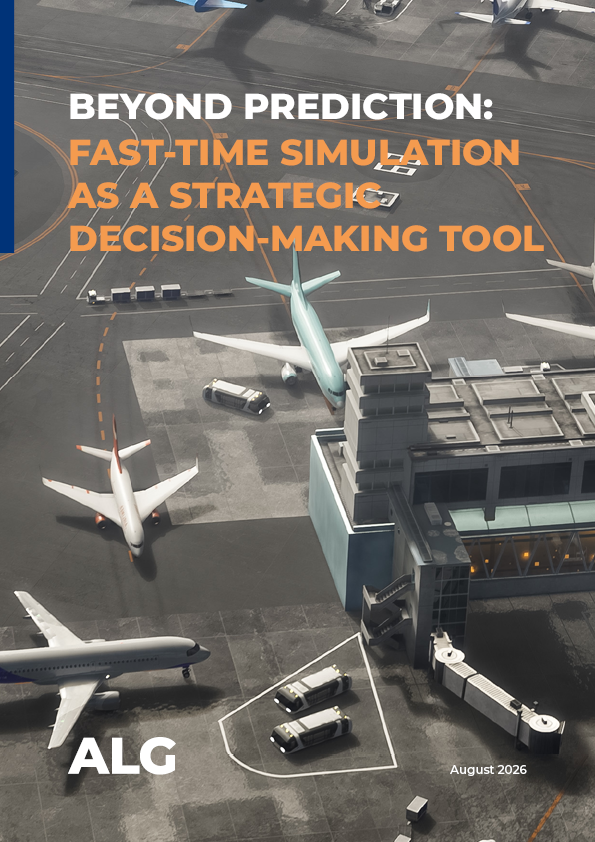
Beyond prediction: Fast-Time Simulation as a strategic decision-making tool
The aviation sector is operating in an increasingly complex environment, where airport infrastructure, passenger flows, airspace operations, sustainability requirements, and traffic growth must be balanced simultaneously. As airports and air navigation service providers face mounting pressure to improve efficiency, resilience, and capacity, data-driven decision-making has become more important than ever.
Fast-Time Simulation (FTS) has emerged as one of the most powerful tools to support this challenge. By creating realistic digital representations of airport and airspace operations, FTS allows organizations to evaluate future scenarios, test operational concepts, identify bottlenecks, and assess the impact of proposed changes before they are implemented in the real world.
Enabling hundreds of operational scenarios to be evaluated in a controlled, risk-free environment, FTS helps decision-makers reduce uncertainty, optimize investments, and develop solutions that balance operational performance, cost, and long-term sustainability.
This paper explores how Fast-Time Simulation is used to assess airport and airspace capacity, identify infrastructure requirements, evaluate operational procedures, optimize resource allocation, and analyze the impact of future traffic growth. It also demonstrates how simulation supports resilience planning by enabling organizations to test contingency scenarios and disruption management strategies before they occur.
In parallel, the paper examines the role of FTS in supporting environmental objectives by quantifying the impact of operational changes on fuel consumption, emissions, taxi times, and overall operational efficiency. Through real-world examples from airport and airspace projects, it illustrates how simulation is helping stakeholders improve performance, strengthen resilience, and support long-term planning decisions.
Finally, the report looks ahead to the future of simulation-based decision-making. It explores how Fast-Time Simulation is increasingly being integrated with digital twins, artificial intelligence, machine learning, and cloud computing technologies, creating more dynamic and continuously updated representations of airport operations capable of supporting faster and more informed decisions.
Download the full report to explore how FTS is transforming airport and airspace planning.
See more insights