

ESG monitoring in road concessions often enters projects through the financing process. Banks, infrastructure funds, multilateral institutions and investors require evidence aligned with frameworks such as the IFC Performance Standards, the Equator Principles, ESG covenants or ESAP-type action plans, as well as periodic performance reporting. This starting point has significantly raised the baseline for environmental and social management in infrastructure.
The limitation appears when ESG monitoring systems are designed primarily to produce evidence for external stakeholders. In practice, a concession requires something more robust: a management scheme capable of detecting inefficiencies, anticipating deviations, reducing incidents, prioritising corrective actions and demonstrating control to lenders, regulators, shareholders and future buyers.
International frameworks should therefore be interpreted not only as compliance requirements, but as a management architecture. The Equator Principles structure the assessment and monitoring of environmental and social risks from a lenders’ perspective, while the IFC Performance Standards provide the technical reference for impact assessment, contractor management, grievance mechanisms and lifecycle monitoring. Together, they connect financial structuring with the real capacity to execute, operate and evidence performance.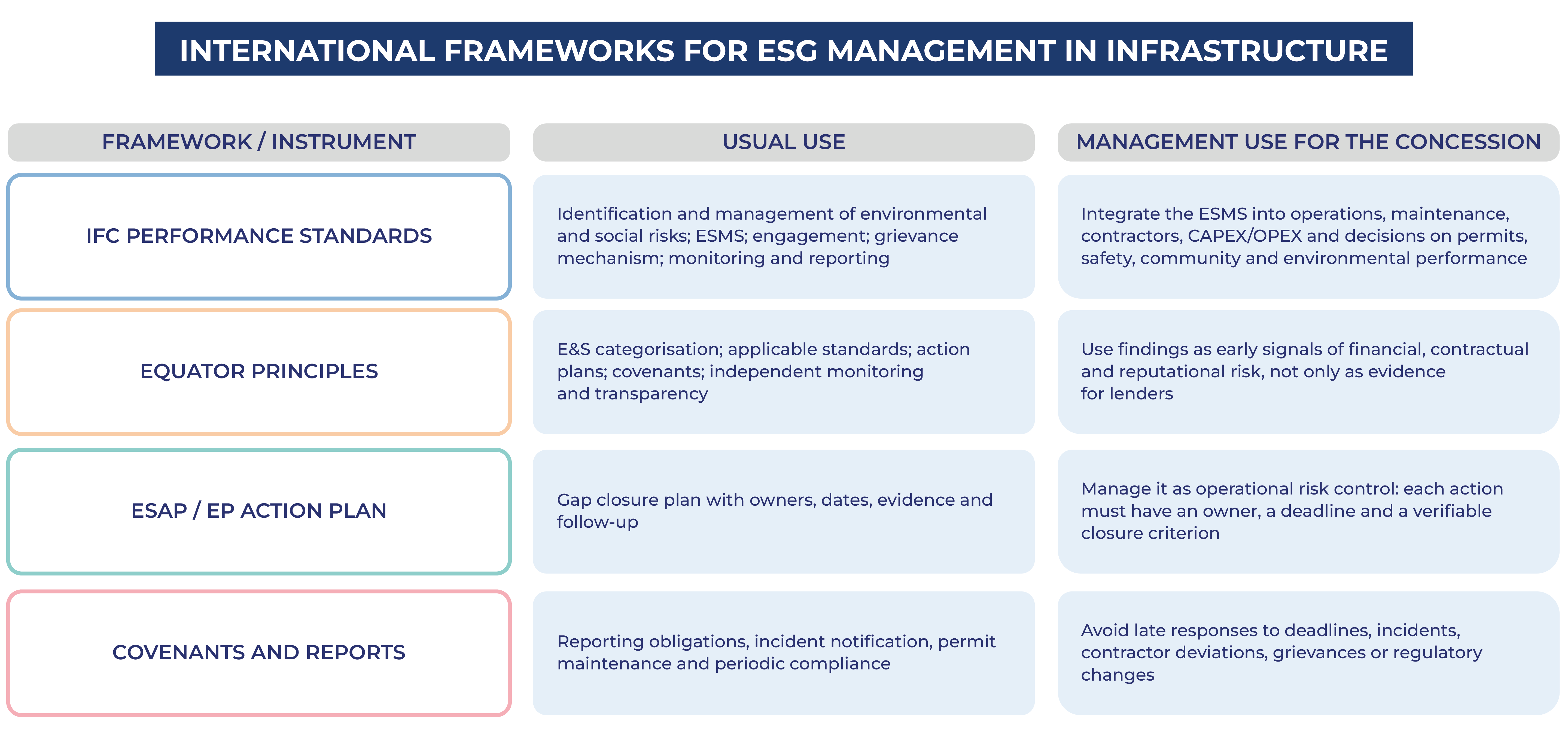 In emerging markets, this reading is even more relevant. Although the domestic regulatory framework may be less demanding than the European one, many road projects are financed with international or multilateral capital. Local authorities and the social context may change, but the expectation of traceability, risk management and evidence remains real.
Anticipating these requirements from the structuring phase, rather than when construction is already under way, can make the difference between an orderly financial close and one that is extended, increases the cost of debt or leaves disbursements conditional on urgent corrective actions.
From compliance to asset control
ESG monitoring is the mechanism that makes it possible to track, verify and correct environmental, social and governance performance during construction, rehabilitation, operation and maintenance. It includes indicators, data sources, responsible parties, thresholds, reports, review mechanisms and corrective actions.
On a road asset, this approach connects with availability, road safety, maintenance, service quality, community relations, contractual compliance and contractor management. ESG stops functioning as a reporting layer and becomes a common language between operations, HSE, environment, contract management, finance and asset leadership.
ESG monitoring methodology for road concessions
To move from compliance to asset management, monitoring must translate international standards, sector materiality and operational reality into useful indicators. This requires reviewing the available information through documentary analysis, testing potential KPIs against the real traceability of the data and validating the selection with the operational teams, the concession company and the corporate ESG area.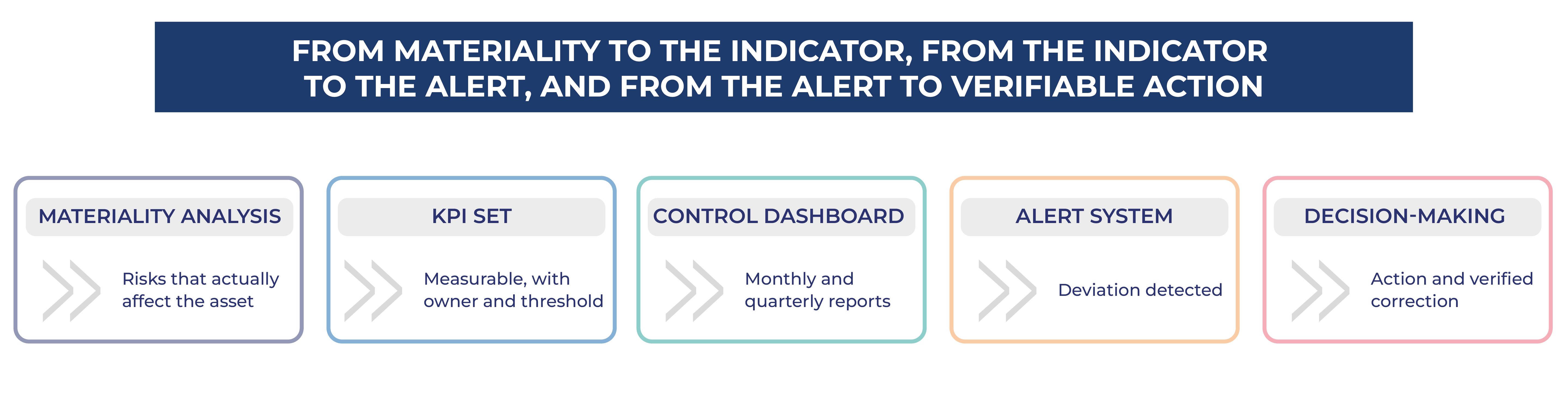
I. Materiality: identifying what really affects the asset
The first step is to produce a short list of topics that may affect the concession's sustainable, contractual and financial performance. To do this, it is useful to cross-reference frameworks such as ICMA, MSCI, SASB, S&P Global and GRI with comparable sector peer references and with the reality of the business model: construction, rehabilitation, operation and maintenance.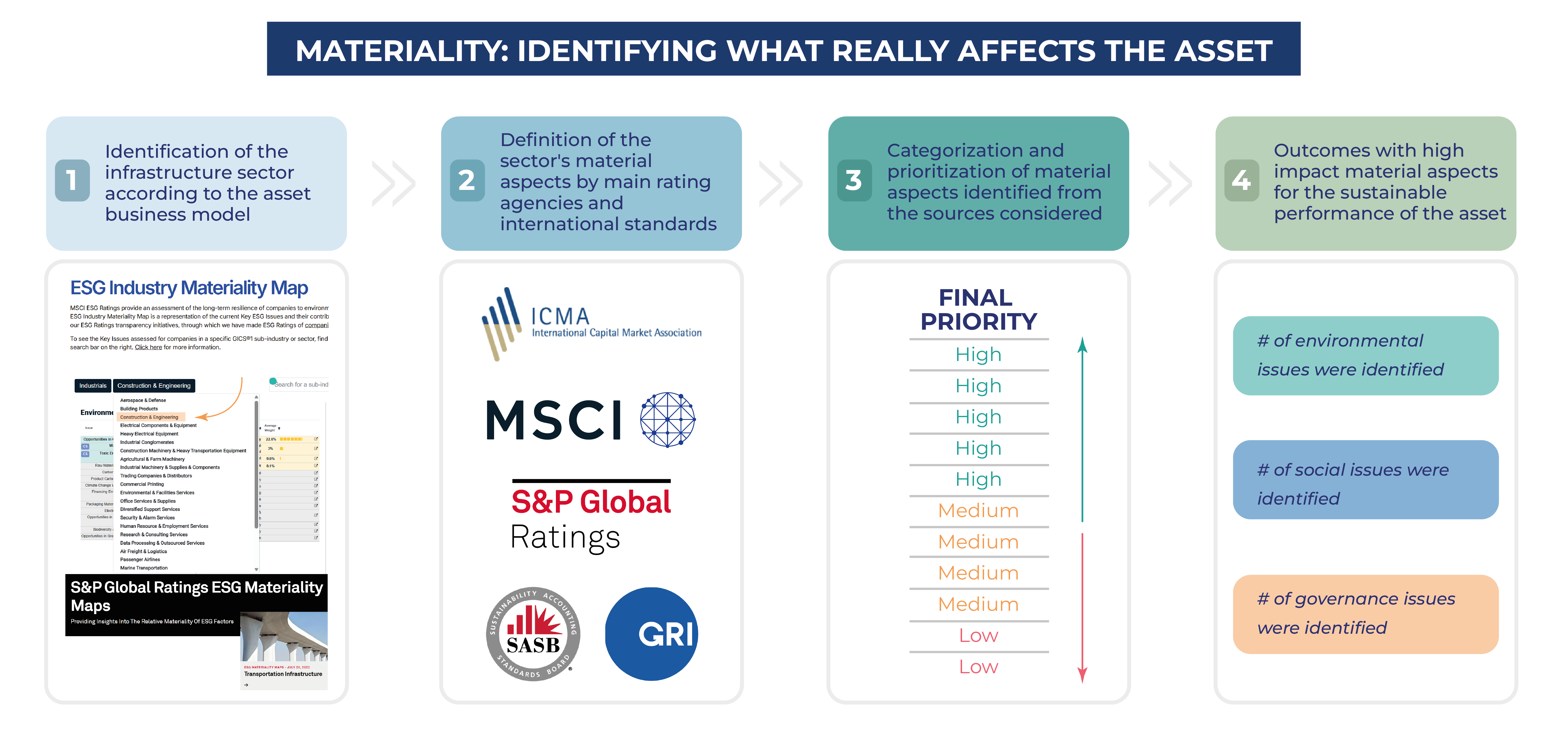
II. KPI: measure only what can be managed
A useful KPI meets five conditions: a traceable source, an operational owner, a reasonable frequency, an alert threshold, and an associated action. If it does not activate a decision, it is probably not a management KPI; it is only a reporting data point.
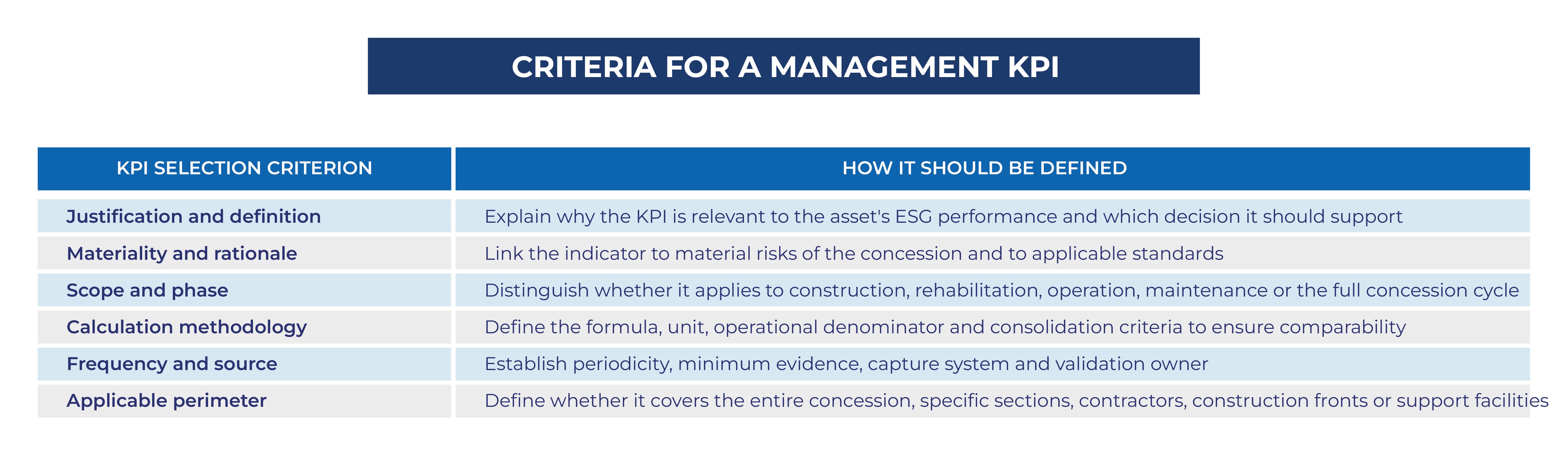
There are two frequent mistakes to avoid when selecting indicators: measuring what is easy but not very material, or importing standard lists without grounding them in the contract, the asset phase and the real measurement capacity. In road concessions, ESG materiality usually concentrates on three fronts: environmental risks that affect resilience and permits; social risks that affect safety, communities and operational continuity; and governance risks that determine contractual control, ethics, traceability and reporting quality.
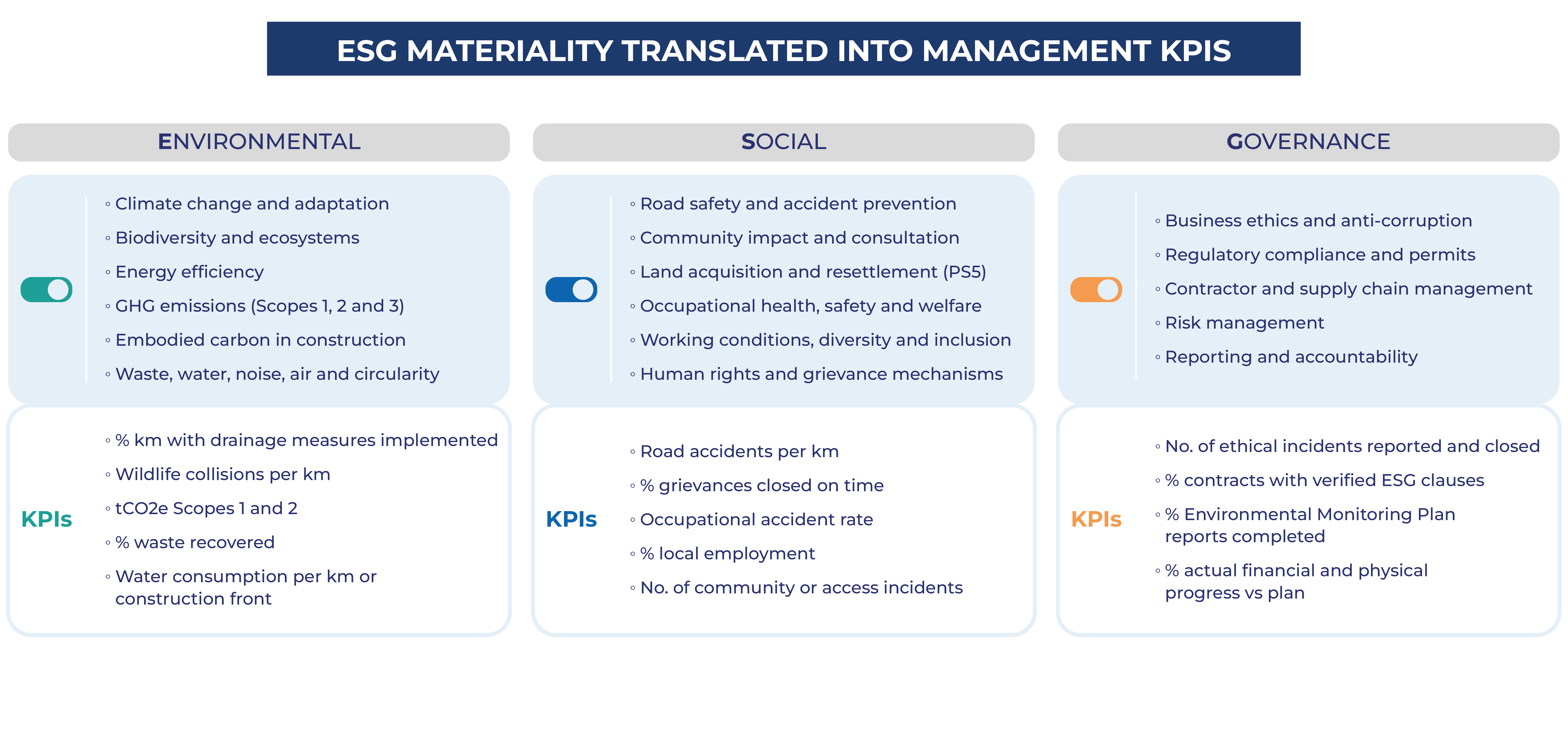
This KPI list must be adjusted and remain dynamic according to the asset phase, local context, contractual obligations and actual data availability. An asset under construction requires greater focus on embodied emissions, earthworks, contractors, OHS, waste, permits and community relations. During operation, greater weight is given to road safety, maintenance, drainage, environmental incidents, grievances, wildlife, energy consumption, service quality and compliance with management plans. The dashboard must change with the project phase; otherwise, it ends up measuring risks that are no longer priorities or leaving out signals that do affect asset performance.
III. Reports and control dashboard as an alert system
The control and monitoring dashboard should not be understood as a repository of indicators, but as an alert system for asset management. Its main function is to identify deviations in time, prioritise corrective measures and ensure that each finding has an owner, a deadline and evidence of closure. In a road concession, this is especially relevant because ESG risks do not usually materialise in isolation: an environmental deviation can lead to contractual non-compliance, an unaddressed community grievance can escalate into social conflict, and a negative accident trend can affect operations, reputation and the relationship with lenders.
A practical monitoring and reporting scheme can be organised in two layers. First, through a monthly report on critical KPIs, focused on the indicators with the greatest direct impact on compliance, safety, operations and commitments with lenders; and second, through a monthly note on dynamic indicators, useful for interpreting variations during construction, operation and maintenance, explaining causes, identifying trends and proposing rapid adjustment measures.
IV. Data governance: who captures, who validates and who decides
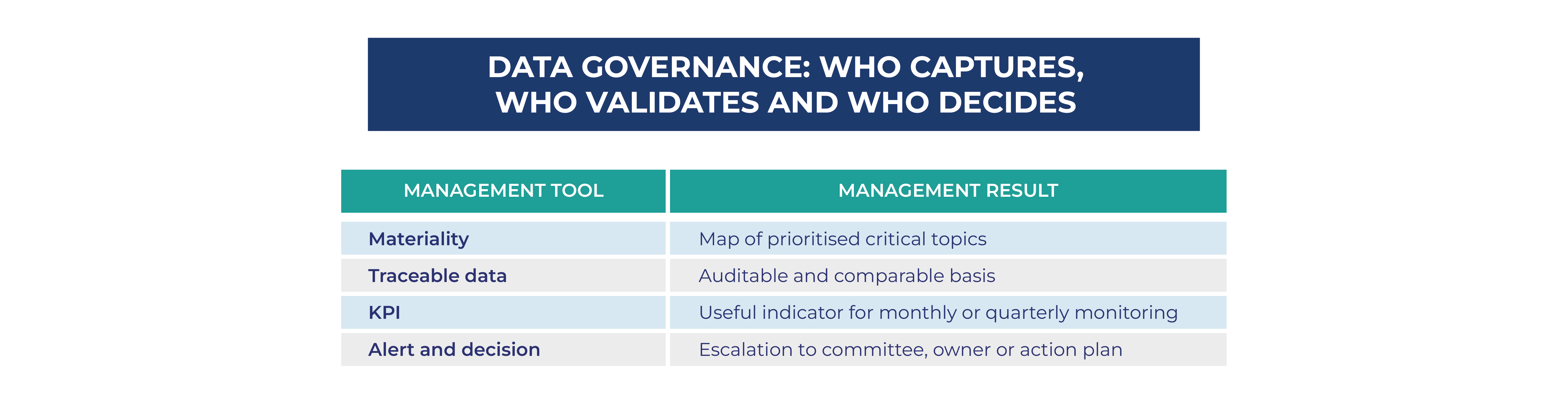
A common gap in concessions is not the lack of data, but the lack of discipline to turn data into management. Contractors report using different formats, incidents are classified inconsistently, permits are reviewed late and indicators are consolidated without sufficient traceability back to the source. When this happens, the dashboard may look complete, but it does not help defend performance or make reliable decisions.
The solution is not to measure more. It is to assign responsibilities and close the loop between data, alert and action. Operations and maintenance must capture the primary information; HSE, compliance and contract management must validate quality, materiality and deviations; management must review a dashboard of critical indicators and decide on budget, contractors, corrective and preventive actions, permits or operational adjustments.
Conclusion: ESG monitoring as a competitive advantage
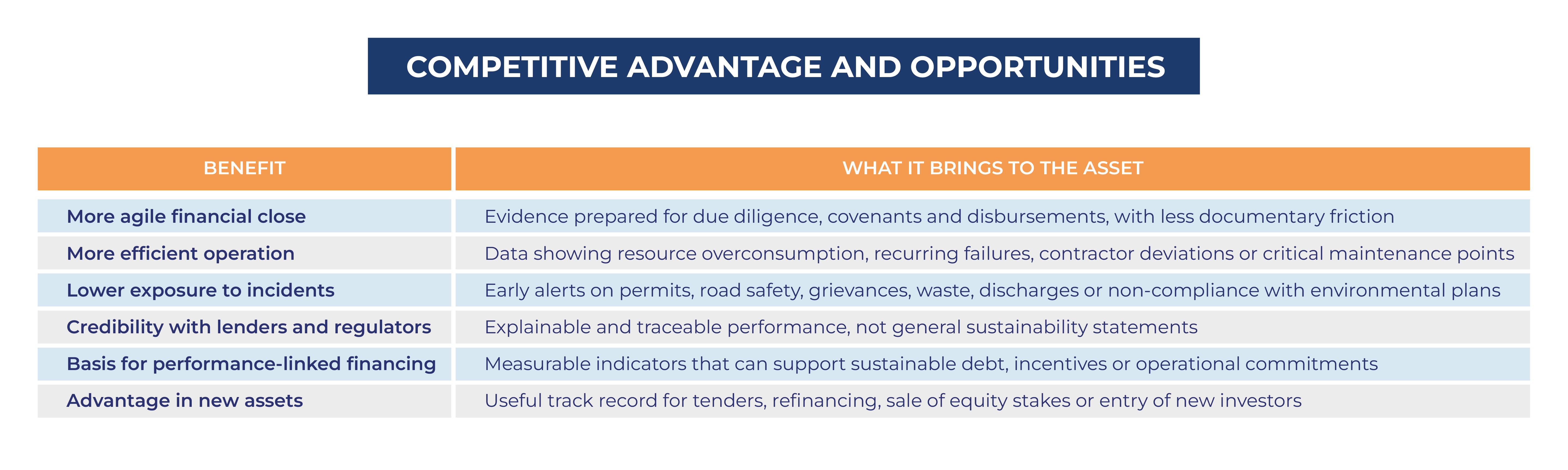
Increasingly, road concessions operate in an environment where lenders, regulators and investors demand clearer, comparable and verifiable evidence on environmental, social and governance performance. The IFC Performance Standards, the Equator Principles, sustainable taxonomies, ESG covenants, climate reporting and transparency expectations are no longer external references to the business: they are part of the everyday language of infrastructure financing, supervision and management. In this context, the real value does not lie in complying with these frameworks defensively or producing isolated reports, but in integrating them into the operational control of the asset.
When ESG monitoring is designed as a management tool, it enables the concession to anticipate risks, reduce friction with lenders and authorities, improve contractor discipline, identify efficiency opportunities and support decisions with traceable data. ESG therefore stops being a documentary burden and becomes a lever to protect value, improve operations and strengthen the concession's competitive position.
Key takeaways for concessionaires
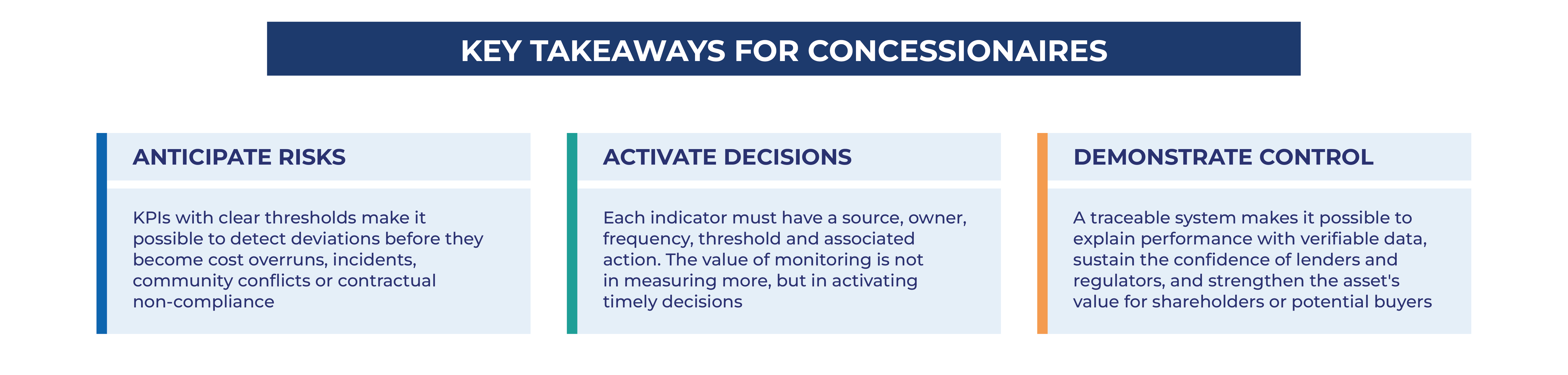 In short, well-designed ESG monitoring allows the concession to stop reacting late and start managing in advance. Its value does not lie in accumulating indicators, but in building a system capable of reading signals, assigning responsibilities, activating decisions and demonstrating results with evidence. In a market where access to capital, regulatory trust and competitiveness in new processes will increasingly depend on the ability to prove performance, concessions that integrate ESG into asset management will be better positioned to reduce risks, capture efficiencies and sustain value throughout the project life cycle.
About the authors

Andrés Ramos Caballero
Economist with MSc in Environmental Governance and Sustainability. Senior ESG Consultant at ALG.

Cesar Valero
Civil Engineer with an MSc and an MBA. Specialist in transport infrastructure with over 30 years of experience in highways, urban mobility, and rail. Experienced in both public and private sectors, focusing on sustainable transportation, transaction advisory, strategic development, and feasibility studies. Partner at ALG.
