

The port of Port of Spain suffered from a number of aspects that were negatively impacting its throughput and financial results, including:
- Old equipment
- Inability to finance capital investment
- Unproductive labour agreement
- Public-sector policies and bureaucracy
- Uncompetitive tariffs due to low productivity and service levels
- Old and inadequate infrastructure
- Non-optimal workforce utilisation
Following the trend to involve the private sector in the development and operation of public ports through Public-Private Partnership (PPP) agreements in Latin America, where 83% of container terminals operate under PPPs, the Inter-American Development Bank (IDB) got involved in supporting the preparation and structuring of a potential PPP for ports in Trinidad and Tobago.
ALG was engaged by the IDB to perform a pre-feasibility assessment for potential PPP arrangements for the Port Authority of Trinidad and Tobago (PATT).
Objectives, goals and purposes
The main objective of the assignment was to support the Port Authority of Trinidad and Tobago (PATT) in studying the feasibility and most appropriate structure for a PPP to attract investors for the assets controlled and operated by the PATT: Port of Port of Spain (PPOS), Port of Scarborough (POSCA), the regional cargo activities at CARICOM Wharves, and cruise shipping operations at PPOS and POSCA.
The specific objectives of the project included:
- Design and definition of a private investment project based on the government’s key priorities for the port sector, economic conditions, private considerations and current global and regional trends.
- Assessment at the pre-feasibility level of potential arrangements for implementing a PPP landlord model, covering institutional, technical, economic, environmental and social aspects, as well as climate considerations, while maximising benefits and value for money for the government of Trinidad and Tobago.
- Performance of an initial financial assessment and preparation of a structuring proposal for the project, determining its bankability and the major obstacles to implementing a PPP under a landlord model.
Study methodology and activities
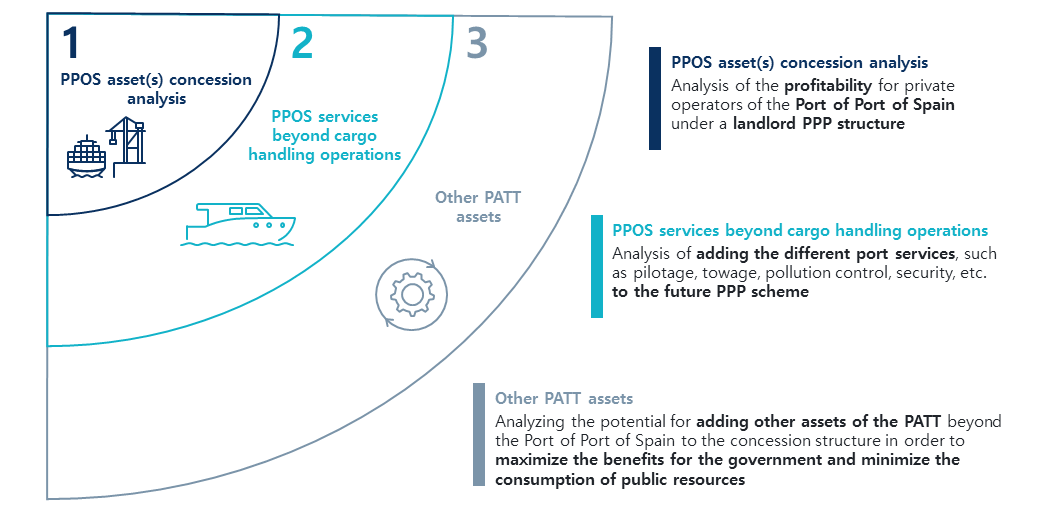
The scope of work covered three blocks:
1- Understanding and review of the project and assessment of red flags:
- Review of existing studies and identification of key aspects and critical issues for a potential PPP
- Assessment of revenue and expenditure structure
- Tariff analysis
- Assessment of operational performance and technical aspects
- Socio-economic analysis
2- Pre-feasibility assessment:
- Preliminary legal, institutional and regulatory due diligence
- Market assessment, traffic study and forecasts
- Benchmarking of PPP structures in the region
- Technical due diligence
- Project development and estimation of CapEx and OpEx
- Socio-environmental assessment
- Financial estimates
3- Conclusions and recommendations:
- Preliminary PPP structuring assessment
- PPP recommendations and definition of next steps
Key findings and recommendations
The main findings of the PPP opportunity were:
- The PATT currently has three distinct lines of activity at its ports (foreign cargo handling, cruises and ferries, and Caricom ports trade). These lines have few synergies and are at different stages of maturity. Therefore, a strategy of three PPPs launched sequentially and independently is the most efficient option.
- Foreign cargo handling is already sufficiently marketable and mature to launch as a PPP and could be bankable with certain combinations of container revenues, costs got operational personnel, concession fees and concession periods.
Success and outcomes
The key findings and outcomes of the PPP pre-feasibility study were a success for the IDB, the government of Trinidad and Tobago and the PATT, which followed ALG’s recommendations for the next steps in the process.
As a result, the IDB officially launched the Port of Port of Spain PPP structuring process in November 2022, in cooperation with the government and the PATT.